
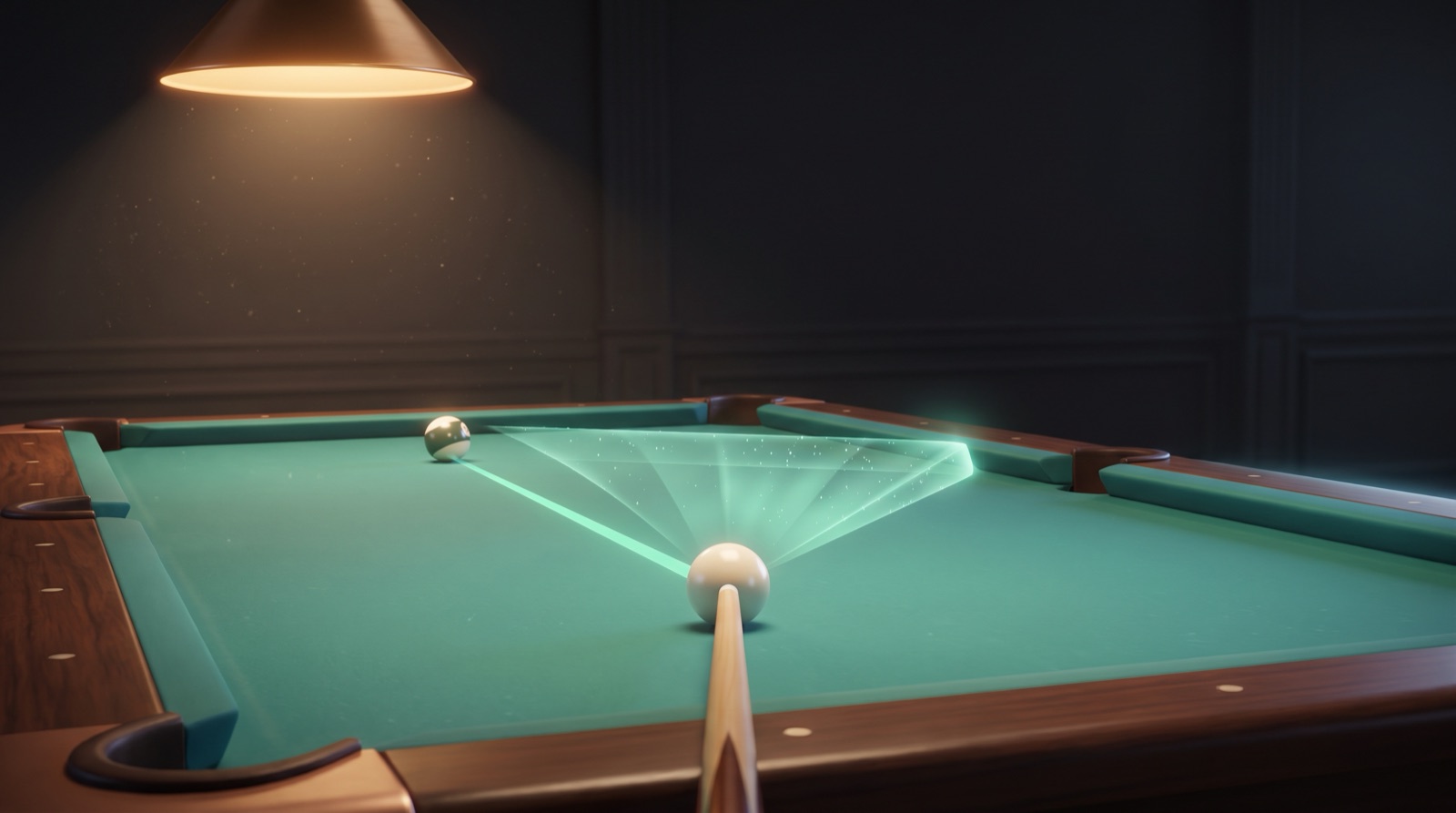
A computer pool opponent does not see the table the way you do. It lists every shot it could play, scores each one, picks the best, and then adds a deliberate aim error sized to its difficulty level. That single fact tells you how to beat it: hand it shots where a small error turns into a miss, and stop giving the strong ones open tables. It also tells you what to expect from an honest game when nobody human is online.
01
How a computer opponent picks a shot
Under the hood, almost every pool AI follows the same loop. For each ball it is allowed to hit, it checks each pocket and asks whether a clean line exists from the cue ball to the object ball and from the object ball to the pocket. Every candidate gets a score: shorter is better, straighter is better, a ball close to the pocket is better, and anything that grazes another ball on the way is worse.
Weak opponents stop there and fire the top-scoring shot. Stronger ones add two things a good human does. They rehearse their best few candidates in the physics engine to see what actually happens, which weeds out shots that would foul or scratch. And they look at where the cue ball finishes, preferring the pot that leaves them a next shot. Only the strongest add banks, kicks, and deliberate safeties when nothing simple is on.
02
Difficulty is aim error, not luck
A computer could pot every makeable ball, so the game has to make it miss on purpose. The fair way to do that is to rotate the perfect aim line by a small random amount before the stroke, with a smaller maximum at each higher level. Duel’s four tiers run from about three degrees of possible error for its Rookie down to about a tenth of a degree for its Shark, and the stronger tiers also rehearse more shots and value position more.
Here is why that matters to you. An angle error grows with distance. One degree at the cue ball moves the contact point by about a centimetre over a short shot and by several centimetres across the full length of the table. On a thin cut, the object ball’s path is even more sensitive to that error than the cue ball’s, so a long, thin cut is where every computer misses most.
A fair AI decides its error before it shoots. Once the ball leaves the tip, it runs on the same physics as yours. Nothing curves to miss, and nothing drops to keep the score close.
03
Beating an easy computer: punish its cue ball
Easy opponents usually do not plan where the cue ball goes. They pot what is in front of them and accept whatever leave follows. You can exploit that without any fancy shots.
- Leave its balls in clusters. Do not break open its group for it. A cluster it cannot pot from is a turn it gives back.
- Leave it long. When you miss, or when you play a soft safety, finish with the cue ball at the opposite end of the table from its best ball. Its large aim error does the rest.
- Take your ball in hand seriously. Weak computers foul often. When they do, place the cue ball for an easy pot and a sensible next position, not just the easiest ball.
04
Beating a hard computer: stop giving it open tables
A top-level computer rarely misses anything open and short, so a shoot-out favours it. The way through is to keep the table closed until you can run out yourself.
First, play safe more often than feels natural. If the pot in front of you is a coin flip and missing leaves an open table, a safety that hides the cue ball behind a blocker is worth more than the pot. Even a strong AI has to kick or poke when it has no direct line, and those are its weakest shots. Second, count balls. If it has fewer balls left and they are spread out, it will win a race, so your priority is making its last few balls awkward rather than potting your own. Third, open clusters on your terms, ideally with a pot that leaves position, not as a hopeful break-out shot that sprays balls for it to clean up.
05
Using the computer as a practice partner
The computer is the most patient opponent you will ever have, which makes it a good coach if you set it up right. Pick the level you beat about four games in ten. Easier than that and you learn to rely on misses that people will not gift you. Harder and you spend most of each rack watching.
Then give each session a single goal. Play a whole match where you must announce a safety before any pot under fifty per cent. Or play one where you cannot shoot until you have said out loud where the cue ball will stop. Losing a few games while you drill a habit is the point.
06
Bot or human: when nobody is online
Online pool has a quiet problem. At three in the morning, or in a new game with a small player base, there may be nobody to match you with. Some games fill that gap with computer opponents given human-looking names and avatars, so the queue always looks busy.
The honest alternative is simple: search for a real player for a fixed time, and if nobody turns up, say so. In Duel, online matchmaking looks for a Game Center opponent for fifteen seconds, and if it finds no one, the screen reads “No opponents online — the house AI steps in” and the computer takes the other seat, labelled as the house AI rather than dressed up as a person.
If a game does not tell you, a few signals are worth noticing. Matches that start instantly at any hour, an opponent who takes exactly the same time over every shot, and play that never hesitates on a hard decision all point to a computer. None of these proves anything alone, but a game that is confident in its player numbers has no reason to hide which opponents are machines.
07
Common questions
Can you play 8 ball pool against the computer?
Yes. Most pool games include a single-player mode where a computer opponent takes the other seat, usually with several difficulty levels. The computer follows the same 8-ball rules you do, including fouls and ball in hand, and in most apps this mode works offline because nothing has to be sent to another player.
How do you beat the computer in 8 ball pool?
Leave it long, thin shots, because a fixed aim error grows with distance and cut angle. Against easy levels, keep the balls it needs tied up in clusters, since weaker AIs do not plan the cue ball. Against hard levels, play safeties instead of low-percentage pots, because a strong computer rarely misses an open shot.
Does the computer cheat in pool games?
A fairly built computer opponent does not. It works out a shot, adds a deliberate aim error sized to its difficulty level, and then strikes the ball through the same physics you use. The error is decided before the stroke, so the ball never bends mid-roll to miss or to drop, and the table never changes its behaviour depending on who is shooting.
How can you tell if an online pool opponent is a bot?
The surest sign is the game telling you, which an honest game does whenever it substitutes a computer. Without that, look for instant matches at odd hours, identical thinking time before every shot, and a player who never hesitates over hard decisions. If a game will not say whether an opponent is human, treat every suspiciously fast match with some doubt.
What computer difficulty should I practice against?
Practice against the level you beat roughly four games in ten. Easier than that teaches you to rely on mistakes that real opponents will not make, and harder than that mostly teaches you to watch. Move up a level once you are winning more than half your games.