
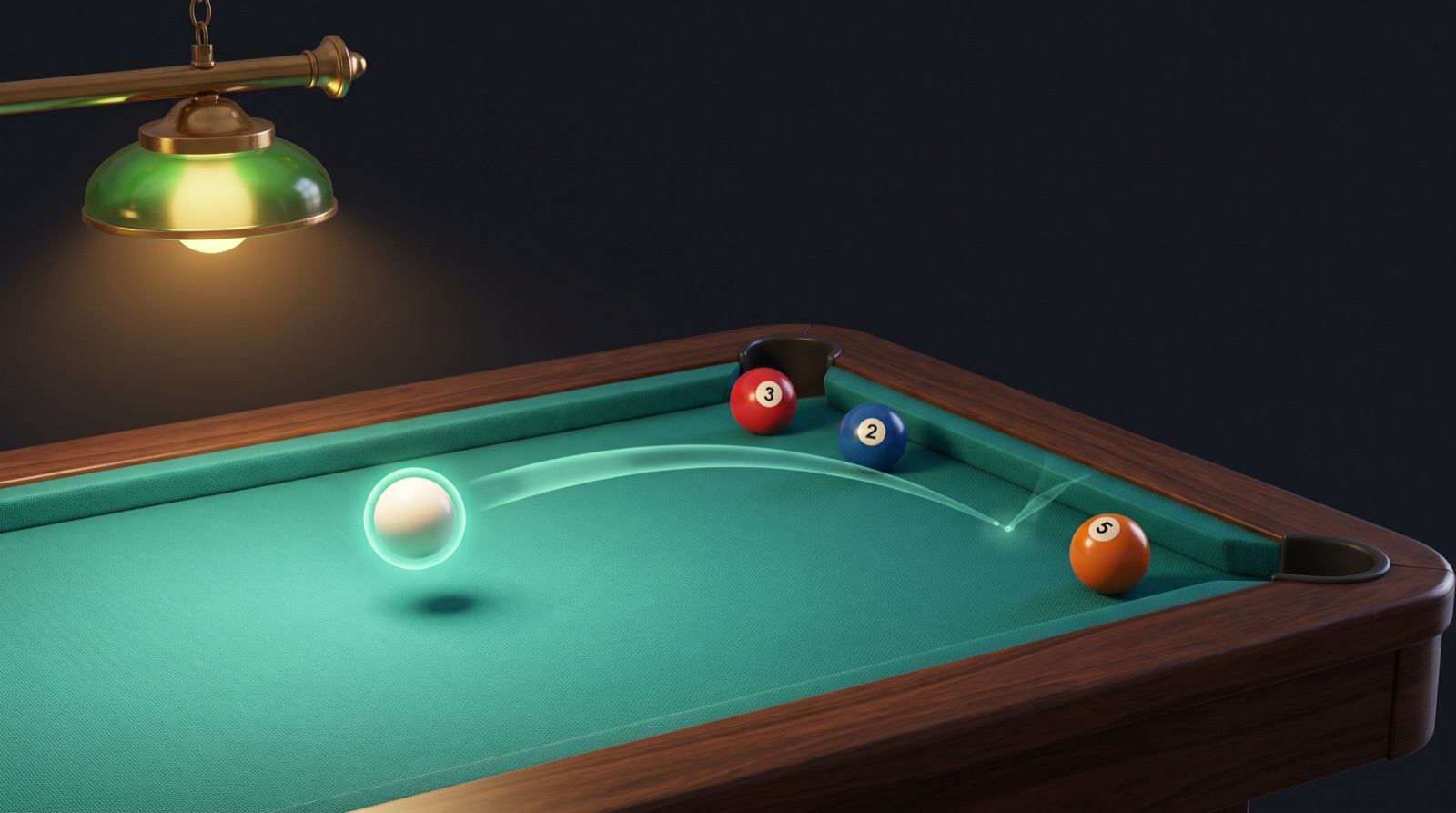
Ball in hand means you pick the cue ball up and put it wherever you want before your next shot. It is the standard penalty for a foul in 8-ball, it applies to the whole table rather than one end of it, and it is the single most valuable thing you can be handed in a rack. Most players waste it, because they place the cue ball where the current shot looks prettiest instead of where the next one needs it.
01
What ball in hand actually permits
When your opponent fouls, the cue ball is yours to position. Lift it off the cloth, set it down anywhere on the playing surface, and shoot. You can put it an inch from your object ball, tight against a cushion, or on the far side of the table if that gives you a better line. You can nudge it, look down the shot, and nudge it again. Nothing is committed until you strike it.
There is no requirement to shoot at the ball you were blocked from before, no requirement to stay on one side of the head string, and no penalty for taking your time. The fouling player has surrendered control of the table, and you are entitled to all of it.
02
The one restricted version: behind the head string
The old restricted form of the rule still exists in one place. If your opponent scratches on the break, you take the cue ball behind the head string—the imaginary line across the head end of the table, the area often called the kitchen—and you must shoot at something on the far side of that line. If the only balls available are also behind the string, they can normally be spotted, or you may shoot into a cushion first and come back.
Everywhere else, ball in hand is unrestricted. This split trips up players who learned on a coin-op bar table, where house rules often apply the behind-the-line restriction to every foul. Neither version is wrong. They are just different games, and the time to establish which one you are playing is before the break, not after the foul.
“Ball in hand” is anywhere on the table. “Ball in hand behind the head string” is a much smaller gift and applies mainly to a scratch on the break. If someone hands you the cue ball and points at the kitchen, ask which set you are playing.
03
Place for the second shot, not the first
Here is the mistake almost every improving player makes: given a free cue ball, they set up dead straight on the easiest ball in front of them. Straight-in shots are simple to pot and terrible for position. A cue ball hit straight through an object ball either stops, follows forward, or draws straight back—all along the same line. You have removed your ability to move sideways at all.
A small cut angle, roughly five to fifteen degrees, is nearly as easy to pot and gives the cue ball a natural path away from the object ball. That path is what carries you to the next shot. So choose the angle by asking a different question: which ball do I want to be on after this one, and what angle sends me there without a hero stroke?
Then go one further. Look at the whole rack and pick the ball you will finish on before the 8-ball—usually the one nearest the pocket you intend to call. Work backwards from there, and the ball in hand decides itself.
04
Three ways to spend it well
Run out. If you can see a route through every remaining ball of your group, this is the moment. Place the cue ball at the start of that route, not at the start of the easiest single shot. Count the shots first; if the plan dies at ball four, it was never a run-out.
Break a cluster. Two of your balls frozen together will end your run whether you deal with them now or later. Ball in hand is the cheapest chance you will get to separate them, because you can choose the exact angle and speed that opens the cluster while still potting something. Do it early, while you have other balls left as insurance.
Play the safety. If the layout is genuinely bad, spending ball in hand on a safety is not cowardice. Place the cue ball where you can nudge one of your own balls to a cushion and leave the cue ball hidden behind a cluster. Your opponent then faces your problem without a free cue ball to solve it with.
05
Freezing the cue ball, and why to avoid it
You are allowed to place the cue ball touching an object ball. It is rarely worth it. Once the two are frozen, most rulesets require you to shoot away from that ball for the contact to be legal, and any forward push into it risks a double-hit foul—the tip striking the cue ball a second time as it moves. That is a judgement call, and judgement calls go against the player who created the situation.
Leave a visible gap instead. A couple of millimetres of daylight preserves every option, removes the argument, and costs you nothing in terms of the angle you were trying to create.
06
Getting the reps in
Ball in hand is a skill you can drill without an opponent. Throw seven balls onto the table, take the cue ball in hand, and run them in a fixed order rather than whatever order looks open. Forcing the order teaches position far faster, because it removes the escape hatch.
A simulator works for this too, provided the physics are deterministic: the same placement and the same stroke give the same result, so you can isolate what your choice of position actually did. In Duel, ball in hand is a drag-to-place cue ball with the behind-the-head-string restriction applied only where the rules call for it.
07
Common questions
Where can you place the cue ball with ball in hand?
Anywhere on the table surface, in any spot where the cue ball is not overlapping another ball. You are not limited to behind the head string and you do not have to keep the cue ball on the same side of the table. The only common exception is a scratch on the break, which in most rulesets restricts placement to behind the head string.
What gives your opponent ball in hand in 8-ball?
Any standard foul: scratching the cue ball, failing to hit any object ball, hitting the wrong ball first, driving a ball off the table, or making contact without pocketing a ball or driving any ball to a cushion. All of these carry the same penalty, which is ball in hand for the incoming player. Fouls involving the 8-ball are the exception, because those end the game instead.
Can you place the cue ball touching another ball?
You may place the cue ball frozen against an object ball, but it changes what counts as a legal shot. You cannot then shoot into that ball in a way that pushes it, and under most rulesets you must shoot away from it or the contact does not count as a legal hit. Leaving a hair of daylight avoids the argument entirely and costs you nothing.
Is ball in hand behind the line or anywhere on the table?
In modern 8-ball it is anywhere on the table. The restricted version, called ball in hand behind the head string, survives only for a scratch on the break in most rule sets. Bar-table house rules sometimes still apply the behind-the-line restriction to every foul, so agree which version you are playing before the break.
Can you move the cue ball with your hand after placing it?
Yes, you can adjust the cue ball as many times as you like until you shoot. You can slide it with your hand, your cue tip, or the ferrule while you look at the angle. The moment you make a forward stroke that strikes the cue ball, the placement is committed and the shot is live.
What is the best place to put the cue ball on ball in hand?
Pick the position that makes your second shot easy, not the one that makes your first shot easiest. A straight-in shot leaves almost no natural cue-ball movement, so a small angle of five to fifteen degrees is usually better because it lets the cue ball drift toward your next ball. Work backwards from the ball you intend to finish on.