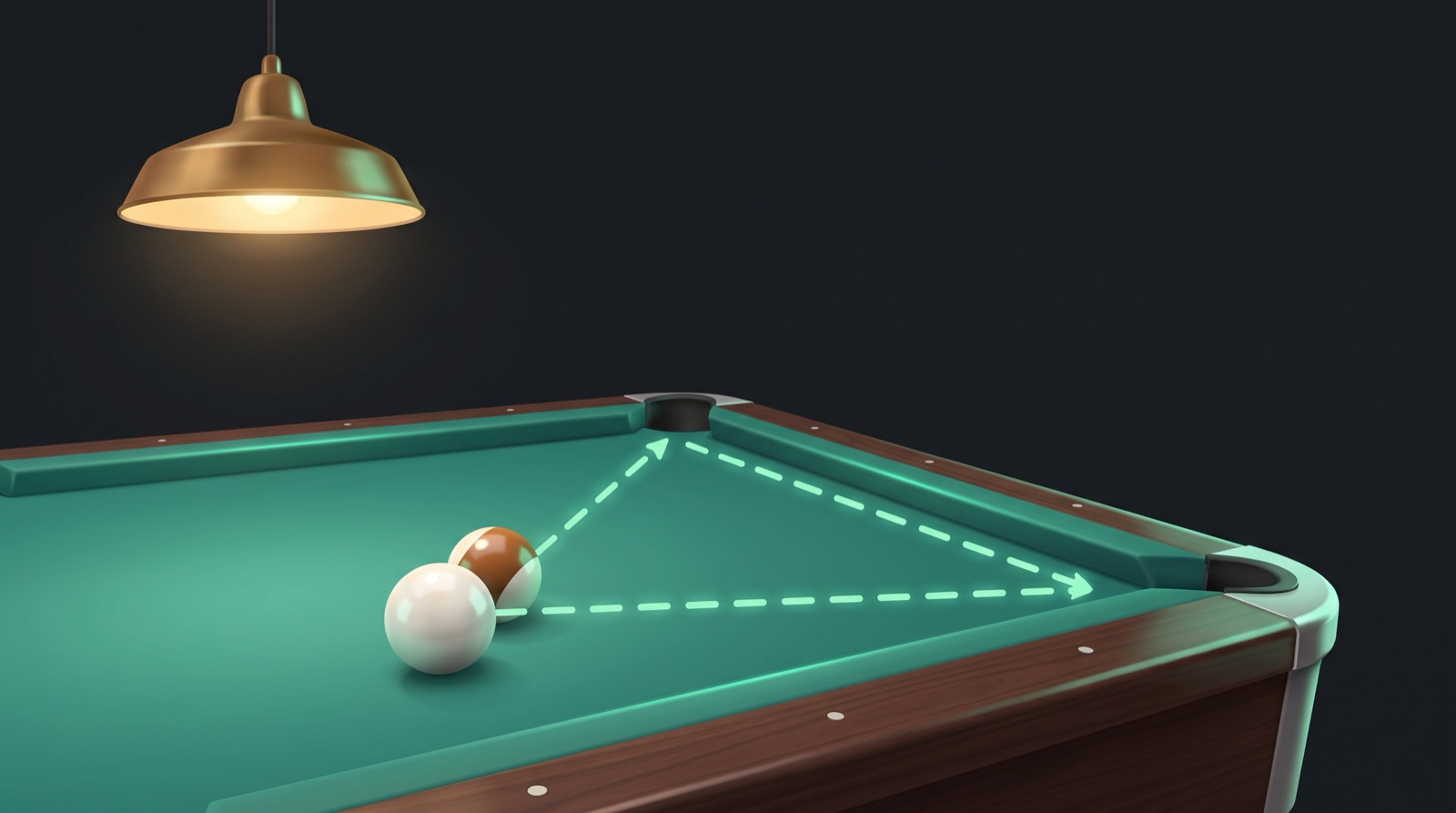
To aim a bank shot, picture the pocket you want reflected through the cushion — as far behind the rail as it sits in front of it — and shoot the object ball straight at that reflection. The rail folds the path back onto the real pocket. That single idea gets you most of the way there; everything after it is a correction for speed, spin, and how hard the ball is being cut.
01
Why the mirror works
A ball leaving a cushion comes off at approximately the angle it went in, the way light leaves a mirror. Angle in, angle out. If that were exactly true, a bank shot would be pure geometry and you could calculate every one of them with a ruler.
The trouble is that people are bad at judging two angles at once: you guess a contact point on the rail, guess the rebound angle from it, then check that the second line lands in a pocket. The mirror trick collapses those three stacked estimates into one aim at one target, which is a thing you already know how to do.
02
How to find the mirrored pocket
Stand behind the shot and pick the pocket you are banking into. Now imagine a second table folded out beyond the cushion you intend to use, a mirror image of the one in front of you. Your target pocket appears in that phantom table the same distance past the rail as the real one sits in from it.
Aim the object ball at that phantom pocket exactly as if the rail did not exist. Where your imagined line crosses the cushion is the contact point, but you never have to name it — you only shoot at the reflection. Then send the object ball down that line using whatever aiming method you normally use, ghost ball included.
Use the diamonds. Count how many diamonds the pocket sits from the corner along the rail you are banking off, then count the same number past the rail in your mind. The diamonds are evenly spaced for exactly this kind of measuring.
03
The correction that matters most: speed
A cushion is not a mirror; it is rubber. Hit it hard and it compresses, and the ball comes out at a narrower angle than it went in — the bank “shortens.” Roll into it gently and the ball comes out wider, or “longer,” than the mirror predicts.
This is the single biggest reason correctly aimed banks miss. Before you start compensating with aim, shoot the same bank three times at three speeds and watch where each one lands. Most players discover their aim was right and their arm was wrong.
04
The correction nobody mentions: cut-induced spin
When you cut an object ball rather than hitting it full, friction at contact leaves it spinning sideways. It arrives at the cushion carrying that spin, the rail grips it, and it kicks out wider than the mirror predicts. The effect is largest on a thin cut into a nearby rail and smallest on a long bank, where the spin wears off against the cloth.
You do not need a number for this, only the direction of the error: cut banks come off wide, so on a thin-cut bank into a close rail, aim a touch shorter than the mirror says.
05
Start with cross-side banks
A cross-side bank — object ball into the long rail, out into the opposite side pocket — is the friendliest bank on the table. The distances are short, so errors have little room to grow, and a side pocket accepts an angled ball better than most players expect.
Set one up: object ball a foot off the long rail near the middle of the table, mirror the far side pocket, shoot at medium pace. Once that goes in four times out of five, move to a cross-corner bank, which asks the same question over twice the distance and with far less forgiveness.
06
When a bank is the right shot — and when it is not
Bank shots are lower percentage than cut shots, so the question is never “can I bank this?” but “is banking better than my alternatives?” Bank when the direct route is blocked, when the cut is barely a shot, or when the bank leaves the cue ball somewhere useful and a safety does not.
Do not bank when a safety would leave your opponent with nothing, or when the path crosses three balls that will deflect it. And remember the rules cost: in call-shot 8-ball you nominate ball and pocket, so a bank that drops somewhere else is not your shot — the ball stays down and your turn ends.
A bank you make one time in three is a bad idea if a safety wins you the table half the time. Count the alternative before you commit.
07
How to practise banks without a table
Banks reward repetition more than almost any other shot, because the skill being built is a calibration: how much this cushion, at this speed, shortens the angle. That is hard to learn in a bar, where you get one attempt before someone else wants the table.
A simulator can substitute, with one requirement — the physics have to be deterministic, meaning the same aim and power give the same result every time. Otherwise you cannot tell whether the bank came up short because you hit it too hard or because the game rolled a dice. Duel runs a fixed-step simulation of cushion rebound and spin, so you can shoot the identical bank at four speeds and read the difference straight off the table.
08
Common questions
How do you aim a bank shot in pool?
Imagine the pocket you want reflected through the cushion, the same distance behind the rail as it sits in front of it. Then shoot the object ball straight at that imaginary mirrored pocket as if the rail were not there. The cushion folds the path back onto the real pocket, so the angle the ball goes in at matches the angle it comes out at.
What is the mirror system in pool?
The mirror system is an aiming method that treats the cushion like a mirror: you picture the table extended past the rail, find the reflection of your target pocket in that phantom half, and aim the object ball at the reflection. It works because a rolling ball leaves a cushion at roughly the same angle it arrived, so the reflected straight line and the real bent path meet the rail at the same spot. It gives you the starting angle, which you then adjust for speed and spin.
Why do my bank shots come up short?
Almost always speed. A hard bank compresses the cushion and the ball rebounds shorter, meaning it comes off at a narrower angle and lands on the near side of the pocket, while a soft rolling bank comes out wider and longer. If your banks consistently miss on the short side, hit them softer before you change your aim, because the aim is probably fine.
What is the difference between a bank shot and a kick shot?
In a bank shot you send the object ball into a cushion and off it into a pocket; the cue ball never touches a rail before contact. In a kick shot you send the cue ball into a cushion first and use it to reach an object ball you cannot hit directly. Bank shots are usually about scoring, kick shots are usually about escaping a snooker and making a legal hit.
Does spin change a bank shot?
Yes, but less than most players think, and only if the spin survives the trip. Sidespin transferred to the object ball is small, and any spin you put on the object ball by cutting it has usually washed off by the time it reaches the rail on a long bank. On short banks it matters more, which is why the reliable way to learn banks is to shoot them with a centre-ball hit and a medium, repeatable speed.
Where do you aim on a cross-side bank?
Mirror the far side pocket through the long rail, then aim the object ball at that reflection. Cross-side banks are the most forgiving bank on the table because the distances are short and the pocket is wide to a ball arriving at an angle. They are the shot to practise first, before you attempt cross-corner banks the length of the table.