
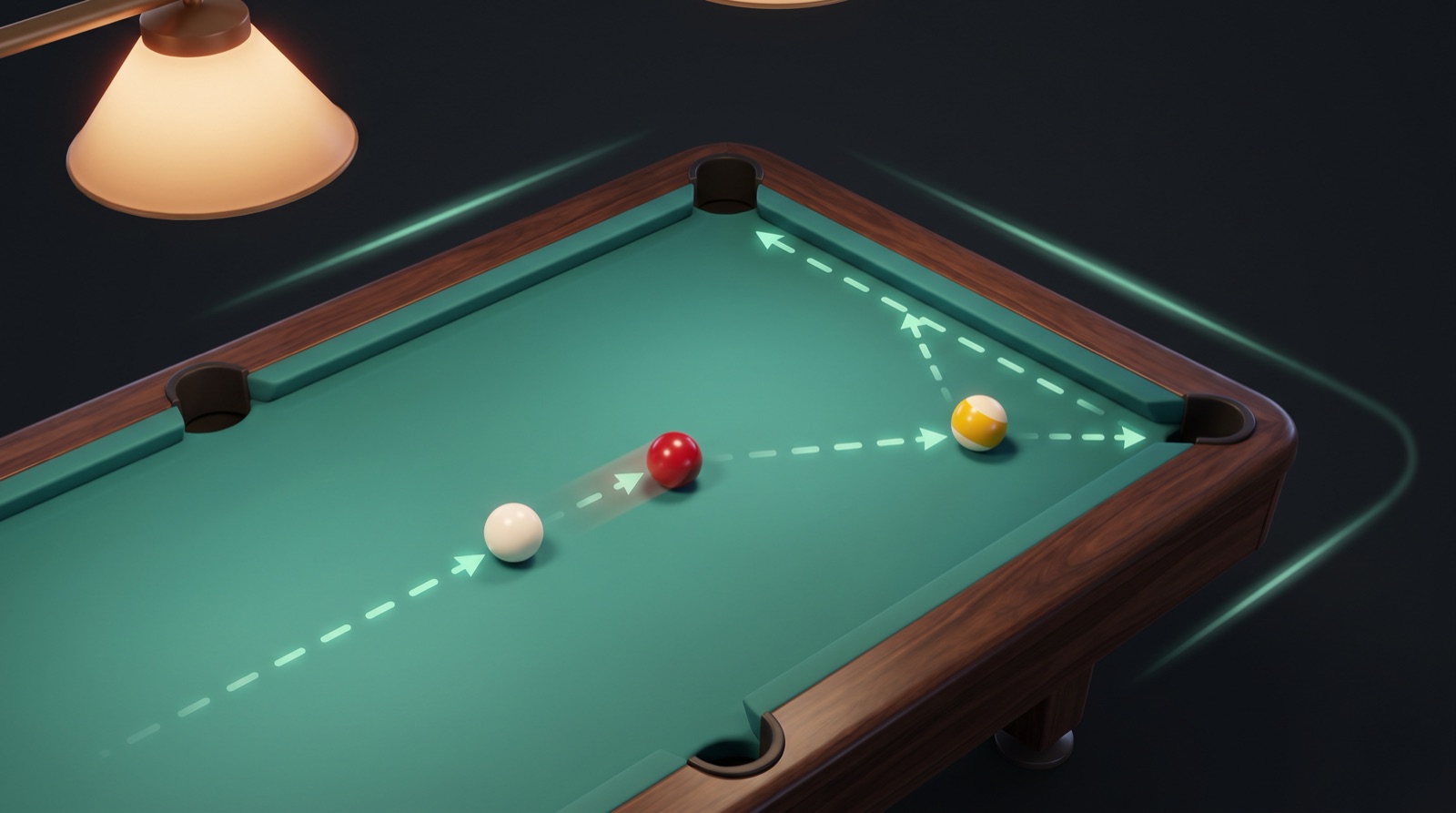
There are eight basic pool shots: the stop, the cut, the follow, the draw, the bank, the kick, the combination, and the safety. The first four are how you pot a ball and decide where the cue ball goes next. The last four are what you play when no clean pot exists. Learn them in that order and you will recognise every shot in a real rack as one of these, or two of them stacked together.
01
The stop shot: the stroke everything else is built on
Put the cue ball, an object ball, and a pocket on one straight line. Hit the cue ball slightly below centre, firmly enough that it is still sliding rather than rolling when it arrives. On contact, the cue ball passes all of its forward speed to the object ball and stops on the spot.
It is the first shot to learn because it is honest. If the cue ball drifts left or right after contact, your stroke was not straight. If it creeps forward, it had started rolling — hit a touch lower or firmer. If it spins back, you hit too low. There is no cut angle to hide behind, so every flaw shows.
02
The cut shot: potting at an angle
Most balls are not straight in. A cut shot strikes the object ball off-centre so it leaves at an angle toward the pocket. The reliable way to aim it is the ghost ball: picture a second cue ball touching the object ball on the exact far side from the pocket, and send the real cue ball to where that imaginary one sits.
The mistake that ruins cut shots is aiming at the contact point on the object ball instead of the ghost ball’s centre. That makes you hit too full, so thin cuts consistently miss on the same side. The thinner the cut, the more it pays to slow down too, because contact friction drags a slow object ball a little along with the cue ball’s path.
Hit with no spin and the cue ball leaves along the tangent line, at 90 degrees to the object ball’s path. That right angle is the starting point for every position decision on an angled shot.
03
The follow shot: the cue ball goes forward
Hit the cue ball above centre and it rolls forward naturally, so after contact it keeps travelling in roughly the same direction. On a straight shot it follows the object ball toward the pocket; on a cut it bends forward off the tangent line.
Follow is the most forgiving spin, which makes it the right first choice for position. Its trap is the straight-in shot near a pocket: a ball rolling forward behind the object ball will often follow it straight in for a scratch. When the pot is straight and the pocket is close, use a stop or a draw instead.
04
The draw shot: the cue ball comes back
Hit below centre with a smooth, accelerating stroke and the cue ball arrives with backspin. On contact its forward motion transfers to the object ball, the spin is left over, and it grips the cloth and pulls back toward you.
When draw fails it is almost never because you hit too softly at the right height. It is because you hit high of where you think, or because the cue ball travelled so far and so slowly that friction wore the backspin away before contact. Get closer, hit genuinely low, and follow through rather than jabbing.
05
The bank shot: the object ball uses a cushion
A bank sends the object ball off a cushion and into a pocket. You play one when your ball has no direct line to a pocket, or when the bank leaves better position than the direct pot would.
The simplest way to find the angle is the mirror method: imagine the pocket reflected on the far side of the cushion, then aim the object ball straight at that reflection. It is a good first estimate. Real cushions shorten the angle slightly at speed and lengthen it when the ball is hit softly, so adjust from there.
06
The kick shot: the cue ball uses a cushion
A kick is the bank shot in reverse: the cue ball hits a cushion before reaching the object ball. Its main job is defensive. When another ball blocks every straight path to yours, you are snookered, and a kick is how you make a legal hit rather than give away ball in hand.
Aim kicks with the same mirror idea, reflecting your target ball through the cushion. Then aim to hit the fattest part of the ball you reasonably can. In a kick the legal contact matters more than potting, and a full hit leaves far fewer accidents behind.
07
The combination shot: one ball pots another
In a combination, the cue ball strikes one object ball, which then drives a second ball into the pocket. In 8-ball the first ball the cue ball touches must belong to your group, so combinations are mostly played from one of your own balls into another.
The rule of thumb is distance. When the two object balls are close together and the second one points at the pocket, a combination can be easier than the shot it replaces. When they are far apart, any small error in the first contact is magnified by the second, and the shot becomes a gamble. Aim the first ball with the ghost-ball method as if the second ball were the pocket.
Two balls touching each other and pointing roughly at a pocket are one of the easiest shots on the table. Hit the first ball anywhere reasonable and the second goes in along the line through both centres.
08
The safety: a shot that pots nothing on purpose
A safety is played to leave your opponent nothing rather than to pot. It must still be legal: hit one of your own balls first, then either pocket a ball or send some ball to a cushion. A good safety leaves the cue ball hidden behind a blocker, frozen to a rail, or a full table length from anything your opponent can hit.
It belongs on this list because it is the shot that separates players who only pot from players who win. When your best pot is a coin flip and a miss hands over an open table, the safety is the stronger shot.
09
How the eight shots fit together
In a real rack these shots stack. A cut with draw. A bank that doubles as a safety if it misses. A kick that nudges a ball into a combination for later. The order above is the order to learn them because each one leans on the one before: the stop shot gives you a straight stroke, the cut gives you aim, follow and draw give you control, and the cushion and defensive shots give you something to play when nothing is easy.
The quickest way to learn any of them is repetition from the same position, so you can tell whether a change in your stroke changed the result. That needs either a real table and patience, or a simulator whose physics produce the same result from the same stroke every time. Duel’s practice mode runs on a fixed-step simulation so a repeated shot is a fair comparison.
10
Common questions
What are the basic shots in pool?
The eight shots every player should know are the stop shot, the cut shot, the follow shot, the draw shot, the bank shot, the kick shot, the combination shot, and the safety. The first four cover how you pot a ball and control where the cue ball goes; the last four cover what to do when no straight pot is available. Almost every shot in a real game is one of these or two of them combined.
What is the easiest pool shot for beginners?
The straight-in stop shot is the easiest, because the cue ball, object ball, and pocket sit on one line and there is no cut angle to judge. Hit the cue ball slightly below centre at a firm pace and it stops dead where the object ball was. Learning it first teaches you a straight stroke, which every other shot depends on.
What is a combination shot in pool?
A combination shot is when the cue ball strikes one object ball, which then strikes a second ball into a pocket. In 8-ball the first ball the cue ball touches must be from your own group, but the ball that drops can be any of yours. Combinations are lower-percentage than direct pots because any error in the first contact doubles by the second, so they are best kept for balls that are close together and lined up with the pocket.
What is the difference between a bank shot and a kick shot?
In a bank shot the object ball hits a cushion before it goes into the pocket. In a kick shot the cue ball hits a cushion before it reaches the object ball. You bank to pot a ball that has no direct line to a pocket, and you kick to make a legal hit when something blocks the cue ball’s path to your ball.
How do you make the cue ball stop after hitting a ball?
Hit the cue ball just below its centre with enough pace that it is still sliding, not rolling, when it reaches the object ball. On a straight shot a sliding cue ball hands all its forward speed to the object ball and stops dead. If it follows forward, hit lower or firmer; if it comes back, hit a little higher or softer.