
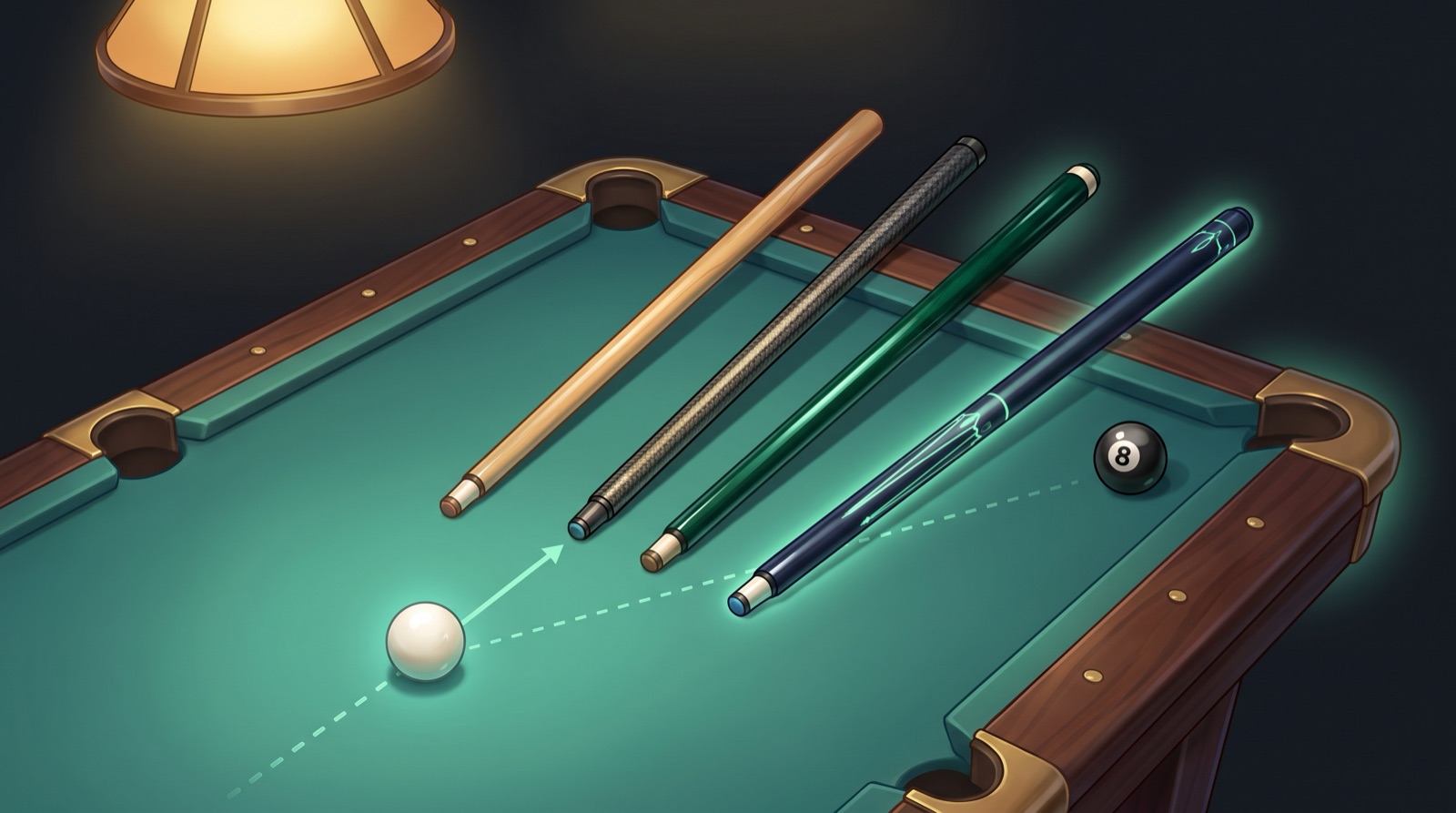
The best cue in an 8 ball pool game is the one that fixes the shot you miss most often — not the one with the biggest total. If you miss cuts, buy aim line. If you pot balls and then have nothing, buy cue-ball path. Power and spin come last, because almost every 8-ball shot is played well inside the limits even a starter cue allows. Here is what each stat actually changes, using one game’s published numbers as the worked example.
01
A cue stat should be a number, not a mood
Most mobile pool games show cue stats as four bars and leave you to guess what a full bar means. That is the first thing to check before you spend anything: can you find out what the bar measures? A stat you cannot translate into a unit is impossible to compare, and a comparison is the whole point of having stats.
Duel: 8 Ball Pool publishes the unit behind every bar, which makes it a useful reference even if you play something else. Its four stats are Guide, Control, Power, and Spin. Two are lengths in meters, two are fractions of a fixed engine limit, and none of them touch the physics itself. The same strike speed and the same tip position produce the same shot whichever cue delivered it.
Ask of any cue stat: does it change what I can see, what I can input, or what the ball does? The first two are fair trade-offs. The third means the table is no longer the same table for both players.
02
Guide: how far you can see the object ball travel
Guide is the length of the predicted path drawn for the object ball after contact. On the starting cue it is 0.3 meters, roughly the width of a hand; on the top cues at full level it reaches 4.0 meters, longer than any shot on the table. Every cue in between sits on a fixed band, and upgrading a cue never shortens it.
Why it matters so much: in real pool, aiming a cut is about finding the ghost ball, the spot the cue ball must occupy at contact. A short guide shows you which way the object ball leaves; a long guide shows you whether it arrives in the pocket. On a long, thin cut the difference between those two is the difference between a pot and a miss, so if your misses are cuts, guide length is the stat worth paying for.
It also has a ceiling you choose. The aim-assist setting caps the line from above, so the line actually drawn is the shorter of your setting and your cue. Turn assist off and no cue in the game will draw a line for you.
03
Control: how far you can see the cue ball go next
Control is the same idea for the cue ball: how far its path after contact is drawn. The starter cue shows none, zero meters, and the ceiling is 2.0 meters. This is the position stat. Potting the ball in front of you is half of pool; the other half is where the white stops, because that decides whether you have a second shot.
A good player predicts the tangent line in their head — on a stun shot the cue ball leaves at ninety degrees to the object ball’s path — and adjusts with follow or draw. A longer control line teaches you that habit by showing it, which is why it is the stat that pays off fastest once your potting is steady. If you keep winning the first ball and losing the rack, this is your upgrade.
04
Power: a share of one fixed top speed
Power is the fraction of the engine’s maximum shot speed your stroke can reach. The starter cue begins at 88 per cent, the top cues reach 100 per cent, and the published band never drops below 85. It scales the whole stroke: pull the slider all the way on an 88-per-cent cue and the engine receives exactly 0.88 of top speed, not a hidden bonus on top.
Here is the honest part: you rarely need it. Most 8-ball shots, from stop shots to gentle position play, are struck at well under half speed, where every cue behaves the same. The extra twelve per cent shows up on the break, where speed spreads the rack, and on long power draws where you need the cue ball to travel a long way back. Buy power last unless breaking is the shot that is costing you racks.
Hitting harder widens your margin for error on nothing. A firm shot needs the same contact point as a soft one, and it throws the cue ball much further out of position when you miss.
05
Spin: how far from centre you can strike
On a real cue ball you can only hit so far from centre before the tip slides off — a miscue. The engine sets that limit at 0.55 of the ball’s radius, close to the real-world rule of thumb of about half a radius. The Spin stat is the fraction of that limit you can use: the starter cue allows 60 per cent of it, about a third of a radius from centre, and the top cues allow all of it.
A third of a radius is already enough for an ordinary draw shot or a touch of side. Full range matters for extreme screw-back, big spin-induced angle changes off a cushion, and fine position on a crowded table. Like power, it scales your input rather than adding anything: push the spin control to its edge and you get exactly the advertised fraction of the limit.
06
Where cue stats should not count at all
The second question to ask of any pool game is where the stats apply. In this example they apply only in coin-stake matches against the computer opponents. Practice ignores them entirely and gives you the full lines, power, and spin, so you can learn the table without owning anything. Local pass-and-play ignores them, and online 1v1 against another person standardizes them, so a head-to-head match is never decided by whose cue cost more.
That split is the right one. Gear that helps you against the house is a reasonable thing to earn; gear that beats another human for you is not. If a game applies paid stats in ranked online play and will not say what they do, the best cue in that game is a decision about money, not about pool.
Missing cuts: Guide. Potting but losing position: Control. Missing draw and side you can picture: Spin. Breaks that do not spread the rack: Power. Everything else is practice, not equipment.
Common questions
What is the best cue in 8 ball pool games?
There is no single best cue; the best one is the cue whose stats fix the shot you miss most. If you miss cuts, a longer aim line helps most. If you pot balls but leave yourself nothing, a longer cue-ball path line helps most, and power or spin only matter once those two are covered.
What do cue stats do in a pool game?
In an honest pool game, cue stats change information and input limits, not the physics. Aim-type stats set how far the predicted lines are drawn, power sets what share of the top shot speed you can reach, and spin sets how far from centre you can strike the cue ball. Two cues hitting the ball with identical speed and tip position should produce identical shots.
Does cue power matter in 8-ball?
Much less than it looks. Most 8-ball shots are played at well under half speed, so a cue that reaches 88 per cent of top speed instead of 100 per cent only changes the break and the odd long power draw. If your power gauge is already the highest stat on your cue, upgrading it further buys very little.
Is the aim line or the spin stat more important?
For most players the aim line matters more, because a missed pot ends your turn while imperfect spin only costs you position. Spin becomes the priority once you reliably pot the ball in front of you and your losses come from the cue ball finishing in the wrong place. Even then, a longer cue-ball path preview often does more for position than extra spin range.
Do cue stats make a pool game pay to win?
They can, which is why it is worth checking where stats apply and whether the numbers are published. A fair design shows the exact number each stat changes, keeps physics identical for every cue, and switches stats off in head-to-head online play. If a game will not tell you what a stat does, assume it is doing more than you think.