
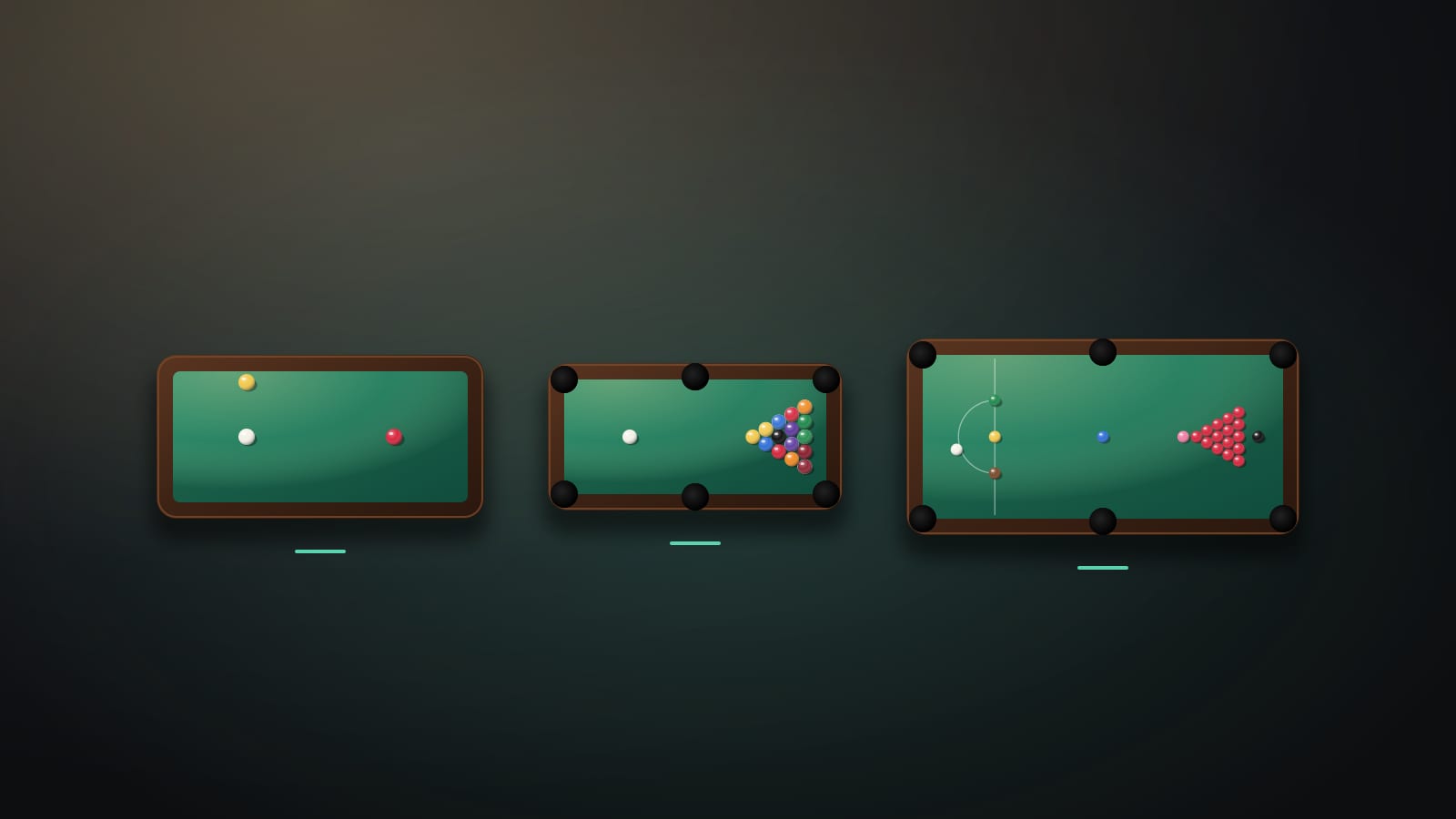
Billiards is the family name for every game played with a cue on a cloth-covered table, and pool and snooker are two members of that family. Used strictly, “billiards” means carom billiards: three balls on a table with no pockets, where you score by making the cue ball hit both other balls. Pool is played on a six-pocket table, usually seven to nine feet long, with sixteen balls. Snooker uses a twelve-foot table, twenty-two smaller balls, and a points system. In the United States “billiards” is also used loosely to mean pool, which is where nearly all of the confusion comes from.
01
Three games, one table shape
All three descend from the same seventeenth-century lawn game moved indoors, which is why they share a rectangular table twice as long as it is wide, a cloth surface, cushioned rails, and a tapered wooden cue. The fastest way to tell them apart is to count two things: the pockets and the balls. No pockets and three balls is billiards. Six pockets and sixteen balls is pool. Six pockets and twenty-two balls on a table you could lie down on is snooker.
02
Billiards: the pocketless original
Carom billiards, also called French billiards, is played on a table that has no pockets at all. The standard competition size is a ten-foot table with a playing surface of roughly 112 by 56 inches, and the slate is often heated a few degrees above room temperature to keep the balls rolling true. There are only three balls, each slightly larger than a pool ball at 61.5 mm: a white cue ball, a second cue ball that is either yellow or white with a spot, and a red object ball.
You score a point, called a carom or a cannon, by striking your cue ball so that it hits both of the other balls. In the simplest form, straight rail, that is the whole rule. In three-cushion billiards, the version played at world championship level, the cue ball must also touch at least three cushions before it contacts the second ball. Games are played to a set number of points, commonly 40 or 50, and a player keeps shooting until they miss. There is nothing to pocket and nothing to pot; the entire skill is in controlling where the cue ball goes after contact.
In Britain, “billiards” usually means English billiards: three balls on a full-size snooker table, which does have pockets. You score by cannons, by potting the red or your opponent’s ball, and by going “in off” a ball into a pocket with the cue ball. It is a hybrid of carom and pocket play and has its own world championship.
03
Pool: six pockets and sixteen balls
Pool is the formal name’s shorthand: pocket billiards. The table has six pockets, one at each corner and one in the middle of each long rail, and comes in three common sizes. Bar tables are seven feet, home tables are usually eight, and tournament tables are nine feet with a playing surface of 100 by 50 inches. The balls are 2¼ inches, or 57.15 mm, and there are sixteen of them: the white cue ball, seven solids numbered 1 to 7, seven stripes numbered 9 to 15, and the black 8. Corner pockets are generous, typically 4.5 to 5 inches across the opening, with angled jaws that accept a ball hit slightly off centre.
“Pool” is really a collection of games on one table. 8-ball assigns each player a group, solids or stripes, and the winner clears their group and then legally pockets the 8. 9-ball is a rotation game: hit the lowest-numbered ball first, and whoever pockets the 9 wins. Straight pool is scored by the ball, usually to 100 or 150, with every ball called. 8-ball is by far the most played, and it is the game most people mean when they say “a game of pool”.
In the United Kingdom and much of Europe, “pool” means a smaller variant again: blackball, played with reds and yellows instead of solids and stripes, with 2-inch balls on a six- or seven-foot table whose pockets are tighter and more rounded.
04
Snooker: the big table and the points system
Snooker is played on a twelve-foot by six-foot table, with a playing surface of about 11 feet 8 inches by 5 feet 10 inches. That is nearly twice the playing area of a nine-foot pool table, and the balls are smaller to match: 52.5 mm, against 57.15 mm in pool. The pockets are cut straight rather than angled, with rounded jaws, so a ball that enters off centre tends to rattle and stay out. Cues are thinner too, with tips around 9 to 10 mm instead of the 12.5 to 13 mm typical in pool.
There are twenty-two balls: the white, fifteen reds worth one point each, and six colours with fixed values. Yellow is 2, green 3, brown 4, blue 5, pink 6, black 7. A visit alternates red and colour: pot a red, then any colour, then another red, and so on, with each potted colour returned to its spot while reds remain. Once the last red is gone the colours are cleared in value order and stay down. Fouls give points to the opponent, a minimum of four. A frame is won on points, a match is a set number of frames, and the maximum break of 147 means fifteen reds each followed by a black, then all six colours.
The name comes from the tactic: to snooker an opponent is to leave the cue ball with no straight path to a ball they may hit, forcing a shot off a cushion.
05
Side by side
Table. Carom billiards: ten feet, no pockets, often heated. Pool: seven, eight, or nine feet, six wide pockets. Snooker: twelve feet, six tight pockets.
Balls. Billiards: three, at 61.5 mm. Pool: sixteen, at 57.15 mm. Snooker: twenty-two, at 52.5 mm. Each step down the list is a smaller ball on a bigger table.
Object. Billiards: make your cue ball hit the other two. Pool: pocket a specific ball or group of balls, depending on the game. Snooker: score more points than your opponent in a frame.
Length of a game. A rack of 8-ball takes a few minutes. A snooker frame takes ten to forty. A game of three-cushion billiards to 40 points can take an hour between good players.
06
Which is harder, and which to learn first
They are hard in different places. Snooker punishes aiming error most, because the pockets are small, the balls are small, and the distances are long. Pool punishes positional error most, because there are fifteen balls in the way and you have to plan a route through them. Carom billiards is the hardest to score in at all when you start, since every point requires the cue ball to find two other balls, often via several cushions.
Learn pool first. The pockets are forgiving enough that you can practise stroke and aim without constant rejection, and everything you build transfers upward: a straight cue action, a ghost-ball aiming picture, stop, draw, and follow, and the habit of thinking a shot ahead. Players who move from pool to snooker find the table enormous for a month; players who move the other way have to learn that cue-ball control decides who shoots next.
If you want to practise the pool side on a phone, pick a simulator that plays by the actual rules. Duel is an 8-ball game specifically, with full 8-ball rules and a tournament ruleset; it does not include snooker or carom, and nor do most pool apps, so check before you download.
07
Why Americans say billiards when they mean pool
For most of the nineteenth century the game played in American billiard halls was carom billiards, and the table was a billiard table. When pocket games overtook it, the word for the table and the room did not change. “Pool” itself started as a betting word: a pool room was where people pooled their money on horse races. That gave “pool” a seedy ring that respectable venues avoided, so many kept calling the game billiards long after nobody in the building was playing carom.
The strict meaning survives in the official names, where the governing bodies still call pool “pocket billiards”. So if someone says they are going to play billiards, they almost certainly mean pool, unless they are in a club with a table that has no pockets.
08
Common questions
Is billiards the same as pool?
Not strictly. Billiards is the family name for every cue sport, and in its narrow sense it means carom billiards, a game played with three balls on a table that has no pockets. Pool is pocket billiards: a six-pocket table and sixteen balls. In everyday American speech the two words are used interchangeably, which is why the question comes up so often.
What is the difference between pool and snooker?
Snooker is played on a twelve-foot table with twenty-two small balls and is scored in points, while pool is played on a seven- to nine-foot table with sixteen larger balls and is usually won by pocketing a particular ball or group of balls. A snooker frame alternates reds worth one point with colours worth two to seven, and the highest possible break is 147. Pool games like 8-ball and 9-ball are shorter, and the pockets are wider relative to the ball.
How many balls are used in billiards, pool, and snooker?
Carom billiards uses three balls: a white cue ball, a yellow or spotted-white cue ball for the second player, and a red object ball. Pool uses sixteen: a white cue ball plus fifteen numbered object balls, seven solids, seven stripes, and the black 8. Snooker uses twenty-two: a white cue ball, fifteen reds, and six colours, which are yellow, green, brown, blue, pink, and black.
Which is harder, snooker or pool?
Snooker is generally considered the harder game to pot in, because the table is far bigger, the balls are smaller, and the pockets are cut tighter with rounded jaws that reject anything hit off the centre. Pool is easier to start but demands more cue-ball control per shot, since you are constantly planning position among fifteen balls on a crowded table. Carom billiards is the hardest to score in at all for a beginner, because every point needs the cue ball to hit two other balls in one stroke.
Is a snooker table bigger than a pool table?
Yes, by a lot. A full-size snooker table is twelve feet by six feet with a playing surface of about 11 feet 8 inches by 5 feet 10 inches. A tournament pool table is nine feet by four and a half, with a playing surface of 100 by 50 inches, and most bar tables are seven feet. A snooker table has nearly double the playing area of a nine-foot pool table.
Why do Americans call pool billiards?
Because for most of the nineteenth century the game Americans played on a cloth table was carom billiards, and the word stuck to the table even after pocket games took over. Pool rooms were originally betting parlours where people pooled money on horse races and passed the time at a billiard table, so the word pool carried a rough reputation and many venues preferred billiards. Today the strict meaning survives in the names of governing bodies, which still call pool pocket billiards.