Cue ball control is deciding where the white will stop before you play the shot, then choosing an angle, a speed, and a tip position that put it there. It is not an advanced skill reserved for people who can draw the ball three cushions. The whole of it fits into four habits: know your next ball before you shoot, work from the tangent line, use speed before spin, and aim for a zone rather than a spot.
01
The shot after this one is the shot that matters
A run of five balls is not five hard shots. It is one hard shot and four easy ones, because each pot was set up by the position left before it. That is the actual mechanism behind every long clearance you have watched and assumed was potting ability.
So the habit to build first costs nothing and needs no technique: before you get down on the shot, pick the ball you intend to play next, and pick which side of it you want to be on. Say it to yourself. Most players discover that they have never once done this, and that simply naming the next ball changes how hard they hit the current one.
You are not trying to pot a ball. You are trying to pot a ball and arrive somewhere, and the second half is the part you can plan.
02
The tangent line tells you where the cue ball is going
At the moment of contact, the object ball leaves along the line joining the two ball centres. The cue ball leaves at ninety degrees to that line. That perpendicular is the tangent line, and it is the single most useful piece of geometry in pool, because it is fixed by the cut angle before you have chosen anything else about the shot.
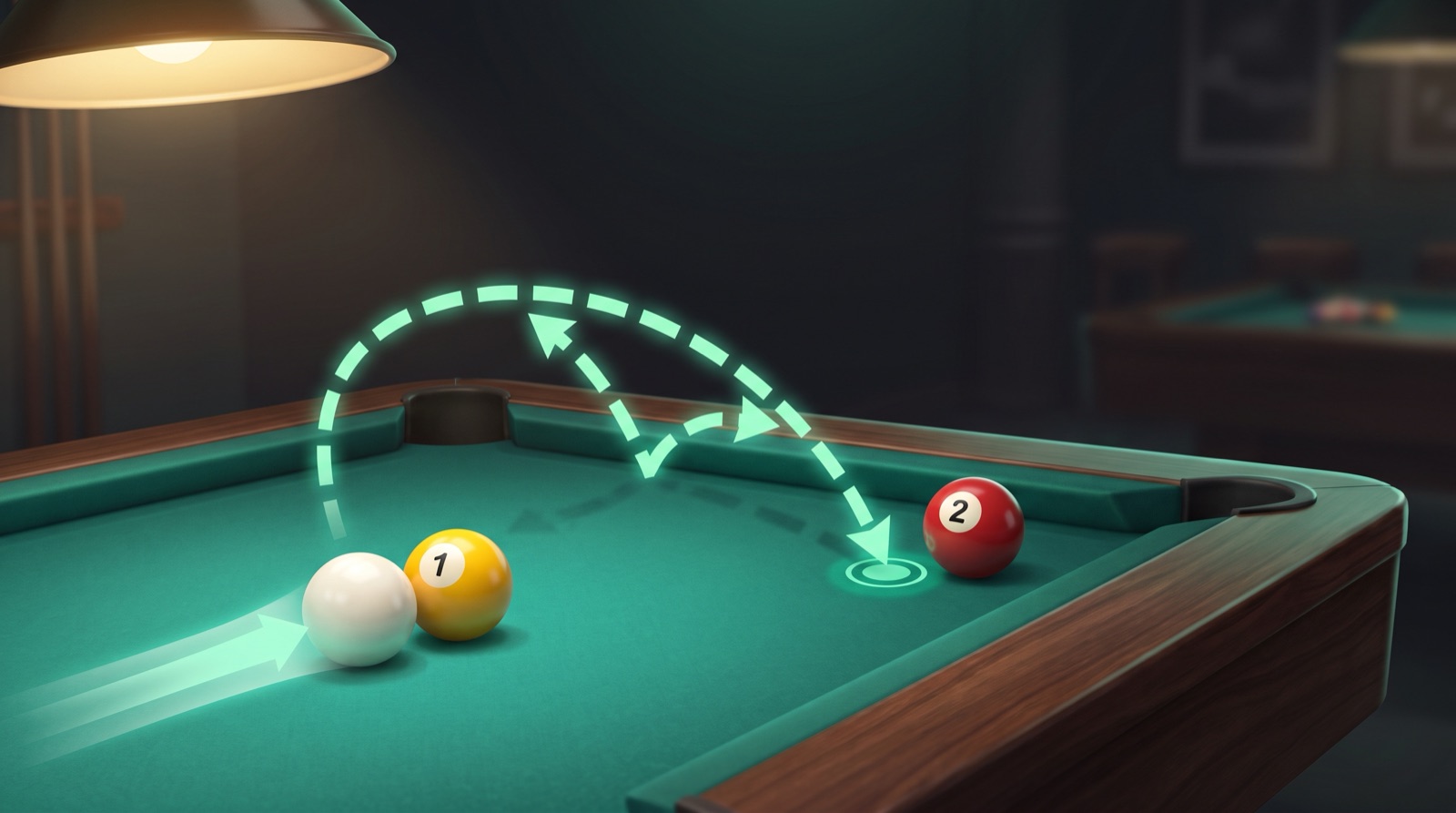
A cue ball that is sliding with no spin left on it travels straight down the tangent line. Add topspin and the path bends forward off the line after contact. Add backspin and it bends back the other way. So the tangent line is your baseline, and spin is a steering input applied to it — not a magic route of its own.
The practical version: stand behind the shot and picture the ninety degree line off the object ball. If that line runs somewhere useful, play a stun shot and you are done. If it runs into a rail you do not want, you now know exactly which direction you need to bend it, and whether that means follow or draw.
03
Speed is your first control, not spin
Improving players reach for english when the answer was almost always pace. Watch a beginner miss position and count the cushions: the cue ball usually arrived at a perfectly good spot and then kept going, picked up two rails and finished behind a cluster. The shot was not wrong. The speed was.
Pace is also the easiest input to control, because it does not depend on hitting a precise point on a curved surface. Build a small vocabulary of speeds — a soft roll that moves the cue ball about a foot past contact, a medium that reaches one cushion, a firm that reaches two, and a break-level hit you almost never need in a rack — and practise recognising which one a position calls for.
There is a risk argument here as well. Every cushion the cue ball touches multiplies the error in your original speed and angle, and adds a chance of clipping a ball you did not plan for. The softest stroke that reaches the zone is nearly always the correct one.
04
Land in a zone, not on a spot
Aiming the cue ball at an exact spot is a good way to feel like a failure on shots that actually worked. Nobody controls the white to the inch. What good players do is identify an area from which the next ball is comfortable — often a patch a foot or more across — and play to land anywhere inside it.
Draw the zone in your head with two questions. Where can I be and still see the next ball cleanly? And where can I be that keeps the angle I want on it? The overlap is your zone. If the zone turns out to be tiny, that is a sign the shot you are about to play is the wrong one, and there is probably an easier route through a different ball.
A wide landing area lets you roll the cue ball gently into place. A narrow one forces a precise pace on you, which is exactly when players start over-hitting.
05
Angles are position, and straight is a trap
A dead-straight pot feels like the ideal, and for cue ball control it is one of the worst leaves on the table. From straight on, the white can only stop, come back, or go forward along a single line. Every other destination is closed to you.
A modest angle — roughly ten to thirty degrees — opens up the whole tangent line and lets the cue ball travel sideways with a rolling, low-risk stroke. This is why professionals so often leave themselves what looks like a harder shot than they needed. They are buying the angle that makes the shot after it trivial.
The corollary is that when you find yourself perfectly straight on a ball, your options have narrowed and you should plan accordingly: stun to stay, follow to move up the line, or draw to come back down it. Fighting for a sideways route from a straight shot means sidespin off a cushion, which is where control goes to die.
06
Plan the end of the rack backwards
In 8-ball, the shot that loses most racks is not a missed pot. It is arriving at the 8-ball with the cue ball on the wrong side of the table and having to play a desperate thin cut with the game on it.
Fix that by planning the last three balls in reverse. Look at where the 8-ball is and decide which pocket you will use, then which position gives you that pot comfortably, then which of your remaining balls can leave you there. Clear the awkward balls — ones frozen on a rail, ones tied up in a cluster — early, while you still have easy balls in reserve to recover with. Save one simple ball near the 8 as your key ball.
This also decides which balls to break out of a cluster and when. The right time is a shot where the cue ball is heading into the cluster anyway and you have a comfortable ball to fall back on afterwards. Not the shot where the cluster is your only remaining option.
07
Three drills that build it
The stop-shot ladder. Set a straight shot a foot from the pocket and stop the cue ball dead. Then move the cue ball a foot further back and do it again, out to the length of the table. You are learning the relationship between distance, speed, and tip height, which is the foundation of everything else.
The two-ball chain. Put two balls on the table, name the order out loud, pot the first and see whether you land on the side of the second that you named. Reset and repeat. This trains the decision, not the stroke.
Speed calibration. Place the cue ball on the head spot and roll it into the far cushion, trying to make it return to a chalk cube you have placed on the cloth. Then a target two cushions away, then three. Pure pace, no potting.
All three want the same shot repeated many times, which is precisely what a busy table does not allow. A simulator does, on one condition: the physics have to be deterministic, so that the same input gives the same result and the only thing that changed was the thing you changed. Duel runs a fixed-step deterministic simulation and shows a projected cue-ball path before the shot, which makes the tangent line visible rather than imagined — a fast way to learn what ninety degrees off the contact line really looks like from a player’s eye view.
08
Common questions
What is cue ball control in pool?
Cue ball control is deciding where the cue ball will stop before you play the shot, and then hitting the shot in a way that puts it there. It is what separates a player who pots one ball from a player who runs several in a row, because every shot in a run is only as easy as the position left by the shot before it. In practice it comes down to three inputs: how full you hit the object ball, how hard you hit it, and where on the cue ball you strike.
How do you control where the cue ball goes after contact?
Start from the tangent line, which is the line at ninety degrees to the direction the object ball leaves. A cue ball struck at centre with the spin worn off travels along that line, and your cut angle sets its direction before you add anything else. From there, topspin bends the path forwards off the tangent line, backspin bends it backwards, and speed decides how far along that curve the cue ball travels.
Is speed or spin more important for position play?
Speed, by a wide margin. Most position errors are shots that were struck too hard, not shots with the wrong spin, and pace is far easier to judge and repeat than a precise tip offset. Learn to reach three or four distinct speeds reliably with a centre-ball strike, and only reach for draw or follow when no speed of centre hit can get the cue ball where you want it.
How far ahead should you plan in 8-ball?
Two balls ahead is enough for most players, and three is enough for almost anyone. Deciding your next ball before you shoot is what converts a pot into position; deciding the ball after that stops you from landing somewhere that only works once. The exception is the end of the rack, which is worth planning backwards from the 8-ball so that your last two balls leave you on the side of the table you need.
Why does my cue ball always end up out of position?
Usually because you are hitting too hard and aiming at a spot instead of a zone. A firm stroke sends the cue ball two or three cushions past a position that a soft stroke would have reached directly, and every extra cushion multiplies the error. Pick an area roughly the size of a beer mat that leaves you a shot, play at the softest speed that will reach it, and accept anywhere inside it as a success.
Should you ever leave yourself a straight shot?
Only when you want the cue ball to stay put or travel straight through the line of the shot. A dead-straight pot restricts the cue ball to going forwards or backwards along one line, so most of the table is unreachable. A slight angle of ten to thirty degrees is the position most professionals aim for, because it lets the cue ball run naturally on to the next ball with a soft, low-risk stroke.