
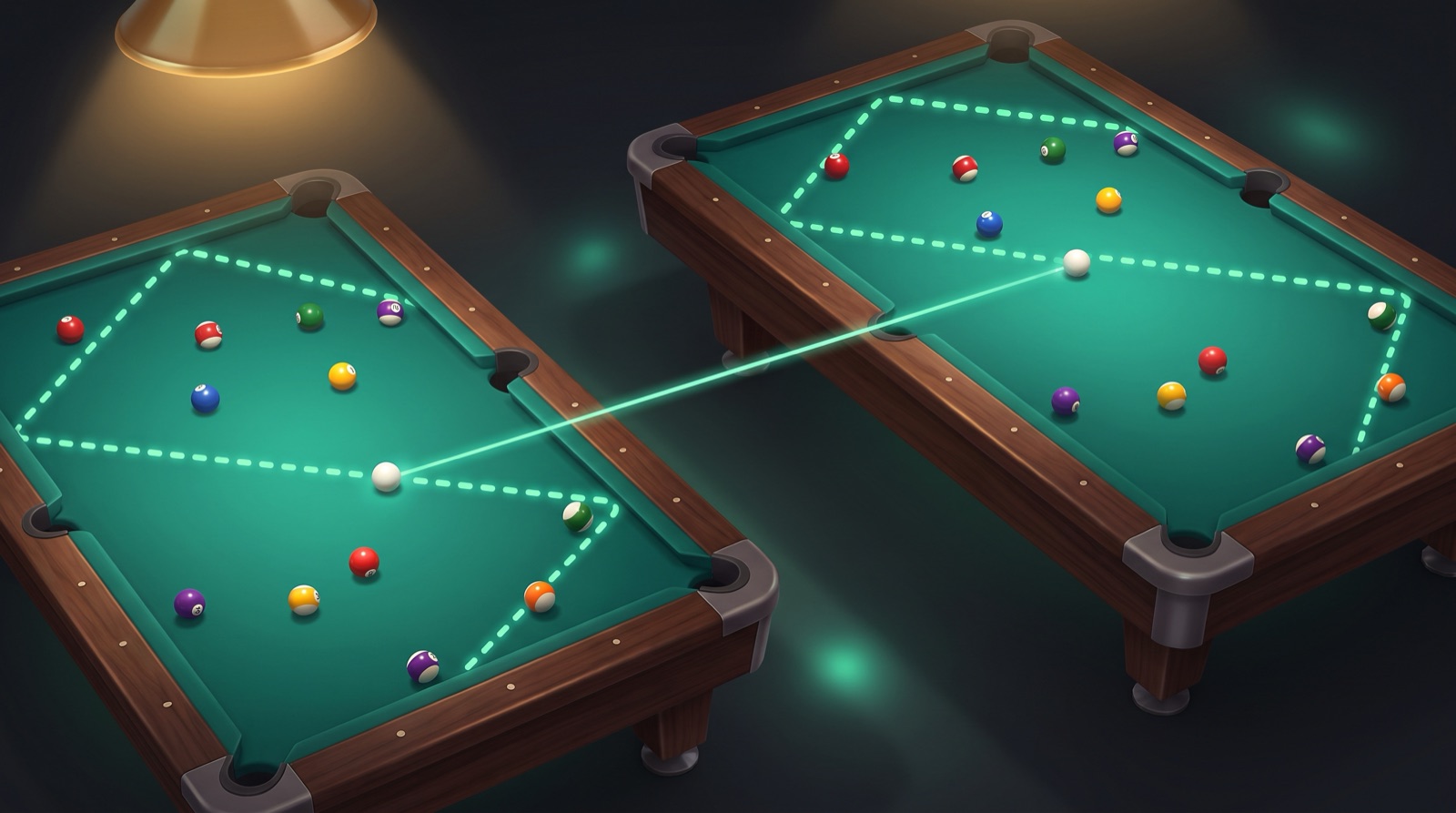
Deterministic physics means the simulation contains no hidden dice. Give it the same table and the same stroke — aim, power, spin — and it returns the same result every time, down to the last millimetre of where each ball stops. For online pool that one property does most of the fairness work: two phones can each compute a shot on their own, land on the identical table, and prove it to each other.
01
Same input, same table
A real pool table is deterministic in principle. Nothing random happens when a cue tip meets a ball; the result follows from speed, contact point, friction, and geometry. Shots only feel uncertain because no human delivers the same stroke twice.
A simulated table can go either way. Built carefully, it behaves like the real one with a perfectly repeatable arm. Built carelessly, or built to manage outcomes, it can return two different results for one stroke. From the outside the two games look alike, which is why the word is worth understanding before you trust a match to one.
A break is the proof. Move the aim by a fraction of a degree and the pack opens in a completely different pattern, because sixteen balls colliding amplify every tiny difference. That sensitivity is real physics. Randomness is something else: the game changing the result when you changed nothing.
02
Four things that quietly break it
Physics tied to the frame rate. If the simulation advances by however long the last frame took to draw, a phone running warm computes a different shot from a phone running cool. The fix is a fixed timestep: the table always advances in identical slices of time and the display simply shows whichever slice is current.
Random numbers in the outcome. A little noise added to aim, to cushion rebound, or to whether a ball hanging in the jaws drops. Sometimes it is there to feel organic. Sometimes it is there to keep matches close.
Order that is not pinned down. When three balls touch in the same instant, the result depends on which collision is resolved first. If that order is left to chance, two devices can disagree on a crowded break while agreeing on every simple shot.
Arithmetic that differs between machines. Different processors and compilers can round the same calculation differently in the last decimal place, and a pool shot runs thousands of steps that magnify it. This is the main reason cross-platform determinism is hard, and why careful games refuse to pair two different physics versions.
03
Why online pool leans on it
There are two ways to keep two players looking at the same table. One is to let a single computer, usually a company server, run the physics and tell both phones what happened. The other is to send only the stroke and have each phone run the shot itself.
Pool suits the second approach unusually well. It is turn-based, and a whole shot is described by a handful of numbers: aim angle, power, the spot the tip strikes, a called pocket, and the cue ball position if it was placed by hand. Send those, and a deterministic simulation on the other side reproduces everything else.
The practical consequence is that lag stops mattering to the result. A slow connection can make your opponent’s shot arrive late. It cannot make a ball skip, teleport, or finish somewhere different on your screen than on theirs, because nothing about the ball’s path was ever sent over the network.
04
The fingerprint check
Agreement is not left to faith. Once the balls stop, each device can boil the whole table down to a short fingerprint — a hash of every ball position plus the state of the rules — and compare it with the other side’s. Matching fingerprints mean matching tables, exactly. A mismatch means something is wrong: a different app version, a bug, or a client that has been tampered with.
This is how Duel runs its online 1v1. Each turn travels as the stroke plus a fingerprint of the table before and after it, stamped with the physics version. The receiving phone replays the stroke through its own fixed 1/120-second simulation and compares. Turns from a different physics version are refused, and a second mismatch in one match ends it rather than letting two players carry on at tables that no longer agree.
05
What that buys you in fairness
No quiet thumb on the scale. A game cannot make the trailing player’s balls roll a little kinder when both phones recompute every shot from the stroke alone. Any nudge would show up as a mismatch.
No invented results. Your opponent’s device cannot simply announce that the 8-ball dropped. It has to send a stroke, and your phone works out for itself what that stroke does.
Equipment you can reason about. If a cue changes power or spin, a deterministic engine applies it as a fixed number to the stroke, the same way every time. There is nowhere for a hidden luck stat to live.
Losses you can learn from. When the same input always gives the same output, a missed shot was your aim, your speed, or your spin. That is uncomfortable and extremely useful.
Determinism checks that the outcome follows from the stroke. It cannot check who chose the stroke. A modified app that picks an inhumanly perfect aim is still sending a legal input, so determinism is a floor under fairness, not the whole building.
06
How to test a game yourself
You need a position you can reset exactly. The opening break in a practice or solo mode is ideal, because the rack and the cue ball start in the same place each time.
Start a rack and break without touching the aim line, the spin, or the cue ball, at full power. Note where four or five balls finish, or take a screenshot. Reset, and do precisely the same thing again. In a deterministic game the two screenshots are indistinguishable. If the spreads differ, the game is either adding randomness or stepping its physics by the frame rate.
A match against a friend offers a second check. Sit side by side, play a few shots online, and compare both screens after each one has settled. Every ball should be in the same place on both phones, not roughly but exactly.
07
Common questions
What does deterministic physics mean in a game?
Deterministic physics means the simulation has no hidden randomness: the same starting position and the same input always produce exactly the same result. In a pool game that means identical aim, power, and spin from an identical table give an identical outcome, down to where every ball stops. It is a property of how the simulation is built, not a setting you can see on screen.
Why does deterministic physics matter for online pool?
It lets both phones compute the same shot independently and arrive at the same table. Only the stroke has to travel over the network, so lag can delay a shot but cannot change where the balls go. It also means each device can check the other, because a result that does not match the stroke that was sent is immediately visible.
Does deterministic mean every break is the same?
No. Deterministic means the same input gives the same output, and on a real break you never give exactly the same input twice. A break amplifies tiny differences in aim and power into completely different spreads, so racks still vary shot to shot. The difference is that the variation comes from you and not from a random number added by the game.
Can an online pool game secretly help one player?
A game with server-side or randomised physics could nudge outcomes without either player being able to tell. A deterministic game that has both devices replay each shot and compare the result cannot do that quietly, because the nudged table would no longer match the one the other phone computed. Asking whether a game replays shots on both devices is the most direct fairness question you can put to it.
Does deterministic physics stop cheating?
It stops one kind of cheating and not another. A player cannot claim a result the physics did not produce, such as a ball that dropped when it should have rattled, because the other device recomputes the shot and sees the mismatch. It does not stop a modified app from choosing a suspiciously perfect aim, since a perfectly aimed stroke is still a legal input.
How can I tell if a pool game is deterministic?
Find a position you can reset exactly, such as the opening break in a practice mode, and play the same shot twice with the aim line and power untouched. If every ball finishes in the same place both times, the simulation is deterministic. If the balls land differently with identical input, the game is adding randomness or tying its physics to the frame rate.