
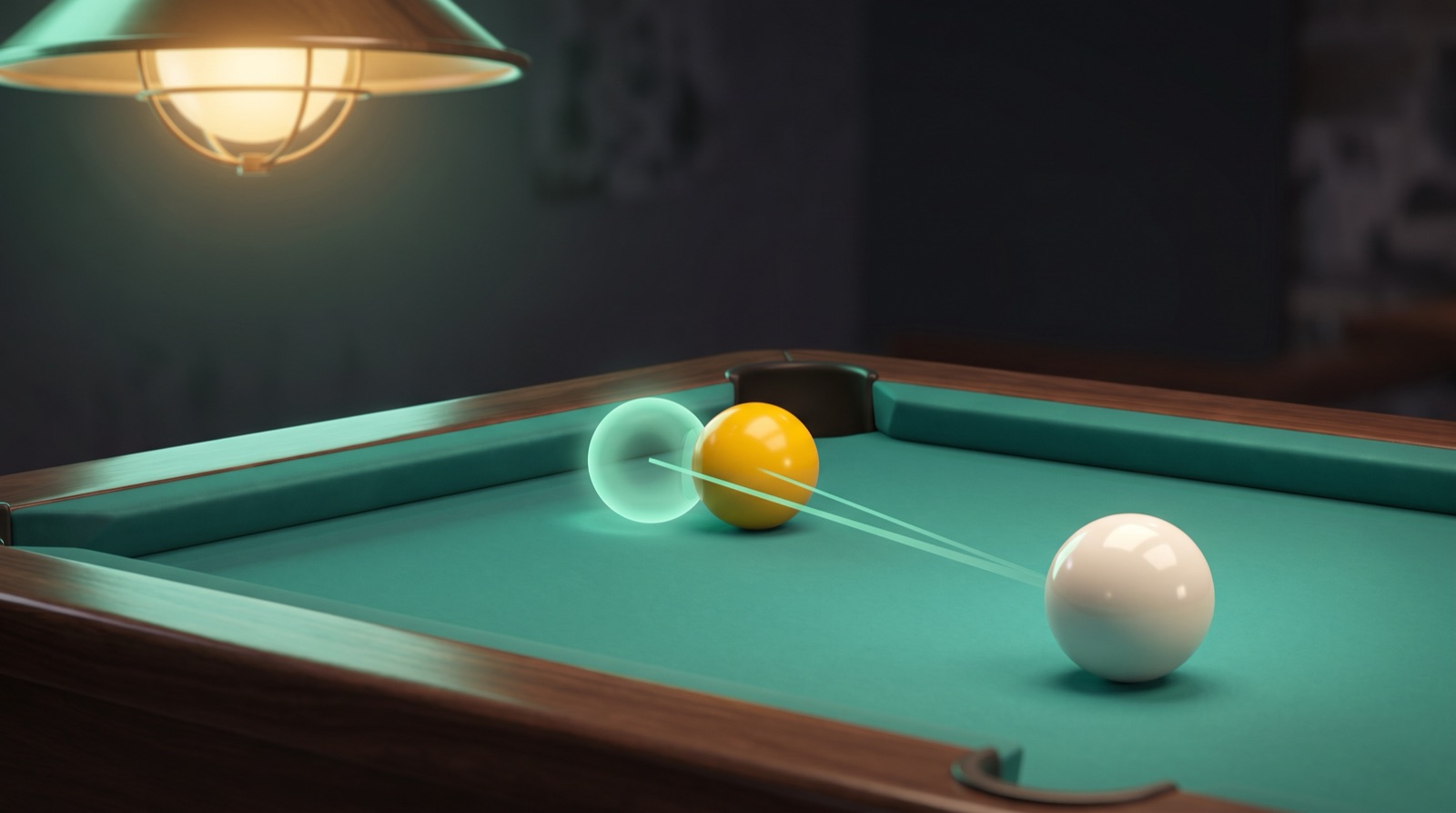
Aiming in pool is one instruction: put the centre of your cue ball where the centre of a phantom ball would sit if that phantom were already touching the object ball on the line to the pocket. That phantom is the ghost ball. Find it, aim at it as though the shot were dead straight, and the cut angle stops being something you have to calculate.
01
Why the ghost ball works
When two balls collide, the struck ball leaves along the line joining the two centres at the instant of contact. Not the direction your cue was pointing, not the direction the cue ball was rolling — the centre-to-centre line. That is the whole of pool geometry, and everything else is a consequence of it.
So work the problem backwards. You want the object ball to travel from where it sits to a specific pocket. That fixes the centre-to-centre line: it must run from the pocket, through the object ball’s centre, and out the near side. Slide a ball along that line until it just kisses the object ball, and you have found the only place the cue ball’s centre can be at contact. Aim there.
The object ball goes where the centres point, so the ghost ball is simply the centre position that makes them point at the pocket.
02
Finding it at the table, in four steps
One: stand behind the object ball, not behind the cue ball. Walk round until you are looking from the pocket back through the object ball. The line is obvious from there and nearly invisible from anywhere else.
Two: mark the far point. Find where that line exits the back of the object ball — the point on its surface facing the pocket — and then find the point directly opposite on the near side. That near point is the contact point.
Three: step the ghost ball out one full ball-width. The ghost ball’s centre is one ball diameter — about 57 mm, not a radius — beyond the contact point, straight out along the same line. This is the step almost everyone gets wrong the first hundred times, and it is why so many players overcut.
Four: walk back and shoot a straight shot. Get down on the line from your cue ball to that ghost centre and deliver it as though nothing were in the way. Do not re-aim once you are down. The angle was decided while you were standing up.
03
The mistake that makes you miss thin
The single most common aiming error is aiming the cue ball at the contact point. It feels right — that is, after all, the spot the balls touch — but your cue ball can never get there. Its centre stops one full ball-width short, on the outside of the object ball. Aim the centre at the contact point and you have driven the whole cue ball half a ball too far around, producing a cut thinner than the one you wanted.
The error is largest on shots near straight, where half a ball is a huge fraction of the available angle, and it shrinks as the cut gets thinner. If your misses have a pattern — the object ball consistently drifting past the far jaw — this is usually the cause, and it is a five-minute fix rather than a stroke problem.
04
Fractional aiming: the shortcut once you trust the geometry
Ghost-ball thinking is precise but slow. Experienced players increasingly think in overlaps instead: how much of the object ball the cue ball appears to cover as it arrives.
A full ball hit is dead straight. A three-quarter ball gives roughly a 15-degree cut. A half ball — the cue ball’s edge lined up with the object ball’s centre — is roughly 30 degrees, and it is the most useful reference on the table because it is the one angle you can see rather than estimate. A quarter ball is roughly 49 degrees, and anything thinner than that is feel and prayer.
The practical method is to identify the nearest fraction, then adjust. “A bit fuller than half ball” is a far easier instruction for your body to follow than “27 degrees”, and it is accurate enough on the majority of shots you will actually face.
Half-ball is 30 degrees, and it is the one contact you can literally see: cue ball edge on object ball centre. Every other angle is described relative to it.
05
Why perfect aim still misses
Throw. The balls rub against one another for a fraction of a millisecond, and friction drags the object ball a degree or two away from the pure geometric line, in the direction the cue ball was moving across it. On a short shot a degree is nothing; on a long shot into a far corner a degree is the whole pocket. Cut shots throw even without sidespin, which is part of why thin cuts are missed thin so often.
Deflection. If you have applied any left or right english, the cue ball does not depart along your aim line — it squirts slightly the opposite way. Your aim was right for a centre-ball hit and wrong for the shot you actually played.
Your stroke. A ghost ball you found correctly is worthless if the cue arrives across the line. Aiming errors cluster around one side of the pocket; stroke errors scatter. If your misses scatter, stop working on aim and go hit fifty straight-in shots instead.
06
Where your eyes should be
Decide the line standing up, then commit. Once you are down on the shot your head is at a different height and your perspective has changed, so any correction you make from there is guesswork correcting knowledge.
On the practice strokes, look at the cue ball to confirm exactly where the tip will land. Then, on the final backswing, move your eyes to the object ball — specifically to the contact point — and leave them there through delivery. Looking back at the cue ball as you strike is one of the most reliable ways to steer a stroke off line, and one of the hardest habits to notice in yourself.
07
Practising aim when there is no table nearby
Aim is repetition. The problem is that a table is a place you have to go, and the shot you most need to practise is rarely the one left on the cloth. This is the one thing a simulation is genuinely good for: the same angle, a hundred times, with instant feedback.
It only transfers if the simulation is honest about the geometry. Duel draws a ghost-ball ring at the predicted contact point, for exactly the reason described above — the ring shows you where the cue ball’s centre will be, which is the target that actually matters, rather than a pre-scripted path to the pocket. The physics runs a deterministic fixed-step simulation with contact throw, so a thin cut drifts the way a thin cut really drifts. Use the ring to calibrate what a half-ball hit looks like from behind the cue ball, then go and reproduce that picture on cloth. A screen will not teach you a stroke, but it will teach you an angle.
08
Common questions
How do you aim in pool?
Draw an imaginary line from the pocket through the centre of the object ball, and continue it one ball-width out the near side. That point is where the centre of your cue ball has to arrive, and it is the only target you need. Aim the centre of the cue ball at that spot — not at the object ball itself — and the cut angle takes care of itself.
What is the ghost ball method in pool?
The ghost ball method means picturing a phantom cue ball frozen against the object ball, positioned so that a line through both their centres points at the pocket. You then aim your real cue ball straight at that phantom ball as though it were an ordinary straight shot. It works because two balls transfer force along the line joining their centres, so putting your cue ball where the ghost sits automatically sends the object ball to the pocket.
Should you aim at the contact point or the ghost ball?
Aim at the ghost ball, not the contact point. The contact point is on the surface of the object ball, and your cue ball can never reach it — its centre stops one full ball-width away, which is why aiming directly at the contact point makes you consistently overcut. The contact point is useful for finding the ghost ball, but the ghost ball’s centre is the actual target.
Where should you look when taking a pool shot, the cue ball or the object ball?
Look at the object ball on your final stroke. Most players check the cue ball on the practice strokes to confirm tip position, then move their eyes to the object ball and leave them there through the shot. Switching your gaze at the moment of delivery is one of the most common causes of a stroke that drifts off line.
Why do I keep missing thin cut shots?
Almost all cut shots are missed on the thin side of the pocket because the ghost ball is harder to see the further it sits around the object ball. Two other effects push the same way: throw, where friction at contact drags the object ball a degree or two toward the direction the cue ball is travelling, and the fact that thin cuts transfer little energy so the object ball rolls slowly and loses line. If you miss thin cuts consistently, aim a touch fuller than looks right and see whether your average improves.
Do professional pool players use the ghost ball method?
Most professionals no longer calculate a ghost ball consciously, but nearly all of them learned through it or something equivalent. After enough repetitions the geometry becomes pattern recognition — they recognise the shot rather than construct it. The ghost ball is the scaffolding you use to build that recognition, and it stays useful for the awkward angles you have not seen a thousand times.