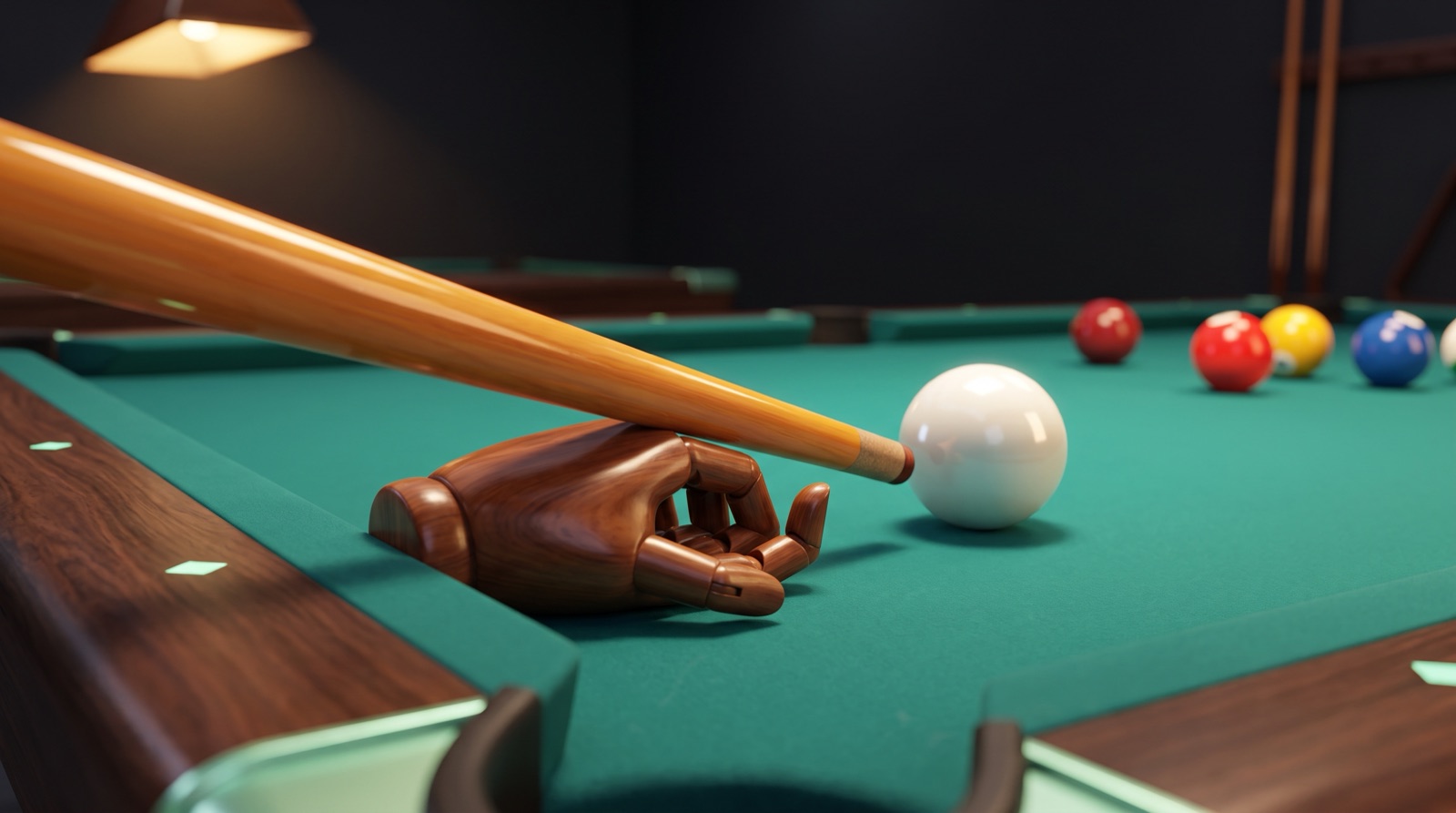
Hold a pool stick with three parts of your body doing three different jobs. Your back hand grips the cue loosely at the point where your forearm hangs straight down. Your front hand forms a firm bridge about eight inches from the cue ball. And your stance keeps your chin over the cue so the stick stays level and only your forearm moves. Get those three right and a straight stroke becomes the default instead of a lucky accident.
01
The grip: looser than you think
The back hand is not there to power the shot. Its job is to hold the cue on a straight line while the arm swings it, and the less it squeezes, the better it does that job. Cradle the cue between your thumb and first two fingers. Your ring and little fingers should touch the wrap but not clamp it. Someone should be able to slide the cue out of your hand without much of a fight.
Tension is the enemy because a clenched hand pulls on the wrist, and a twitching wrist steers the tip sideways at the last moment. That is why so many beginners aim a straight-in shot perfectly and still miss it. The aim was fine; the grip changed it during the stroke.
Take a few practice strokes holding the cue with only your thumb and index finger. If the cue still tracks straight, your grip was doing too much before. Add the other fingers back without adding the squeeze.
02
Where to hold it: find the vertical forearm
There is no fixed number of inches from the butt, because arm lengths differ. The reliable rule is this: get into your stance, put the tip right next to the cue ball, and slide your back hand along the cue until your forearm points straight down at the floor. That is your grip point. For most adults it lands a hand or so behind the balance point, somewhere near the back of the wrap.
The reason is geometry. Your elbow is a hinge, and a hinge swings a straight line only near the bottom of its arc. With the forearm vertical at contact, the tip is travelling flat and level exactly when it meets the ball. Grip too far forward and the stroke shrinks to a short jab. Grip too far back and the forearm swings past vertical at contact, so the tip is rising as it hits.
03
The bridge: the part that should not move
If the grip is loose, the bridge is the opposite. It is the fixed guide the cue slides through, and it has to stay planted on the cloth through the whole shot.
The open bridge. Lay your front hand flat on the table, spread the fingers, and lift the knuckles slightly so the heel of the hand and the fingertips carry the weight. Press your thumb against the side of your index finger, just below the knuckle, and you have a V-shaped groove. Rest the cue in it. This is the bridge to learn first: it is stable, it is easy to repeat, and nothing blocks your view of the shot line. Raise or lower the knuckles to hit the cue ball higher or lower.
The closed bridge. Start from the same flat hand, then curl your index finger over the cue and touch its tip to your thumb, forming a loop the shaft runs through. It holds the cue more securely, which is why good players use it for power shots and screw. Keep the loop snug but not tight, or the shaft will stick.
The rail bridge. When the cue ball sits near a cushion, rest your hand on the rail and guide the cue between your fingers along the top of it. You lose some ability to hit low on the ball, so plan shots near the rail with that in mind.
Keep the bridge about six to ten inches from the cue ball. Every extra inch of bridge length magnifies any sideways drift in your stroke, and too short leaves no room for a backswing. Go shorter for delicate touch shots and slightly longer for a break.
04
The stance that keeps it all in line
Stand behind the shot and walk into it along the line you intend the cue ball to travel. For a right-handed player, the right foot lands on or near that line and the left foot steps forward and a little to the left, roughly shoulder-width apart. Left-handers mirror everything. Bend from the hips, not the back, and bring your chin down over the cue. Beginners stand too upright, which forces the back of the cue up and the tip down into the cloth.
You are aiming for a cue that is as close to level as the table allows. A cue angled down drives the ball into the slate and, the moment you add side spin, makes it swerve off line. Only raise the butt deliberately, when you must reach over a rail or another ball.
05
The stroke: only the forearm moves
With grip, bridge, and stance set, the stroke is simple to describe and hard to keep honest. Your upper arm stays still. Your shoulder stays still. Your head stays still. The forearm swings back and through from the elbow like a pendulum, and the cue follows. Take two or three slow practice strokes, pause briefly at the back, then accelerate smoothly through the ball and let the cue carry on a few inches past where the ball used to be.
Then stay down. Popping up to watch the shot drop is the single most common way good setups get ruined, because the body starts moving before the tip has finished. Freeze until the object ball has reached the pocket.
06
The mistakes that feel normal
The death grip. White knuckles on the back hand mean the wrist is steering. Loosen it until it feels almost too casual.
The wandering bridge. If your front hand lifts or slides as you shoot, the cue has no fixed guide. Press the heel of the hand into the cloth before every shot.
The chicken wing. An elbow that sticks out sideways swings the cue across the line rather than along it. Your elbow should sit roughly above the cue, in the same vertical plane.
The overlong bridge. Reaching for a shot with a fifteen-inch bridge feels comfortable and misses. Move your feet instead, or use the mechanical bridge — the rest, or rake — which is a legitimate tool and not an admission of defeat.
07
A five-minute drill for a straight stroke
Put the cue ball on the head spot and shoot it straight up the table over the foot spot, into the far cushion and back. If your grip, bridge, and stance are aligned, it returns along the same line and comes back to your cue tip. If it drifts left or right, the error is in your stroke, not your aim, because there was nothing to aim at. Ten of these at the start of every session is the most useful warm-up in pool.
The physical grip only comes from a real cue on a real table. What you can practise anywhere is the thinking that sits on top of it — aim, spin, and where the cue ball goes next — which is where a simulator like Duel is useful, since it models those decisions rather than your hands.
08
Common questions
How do you hold a pool stick properly?
Hold the back of the cue loosely with your dominant hand, at the point where your forearm hangs straight down when the tip is at the cue ball. Rest the front of the cue on a bridge made by your other hand, about eight inches from the ball. Stand side-on with your chin over the cue so the stick stays level and only your forearm swings.
How tight should you grip a pool cue?
Barely tighter than you need to stop it falling. The thumb and first two fingers cradle the cue while the last two fingers only touch it, so the stick can swing freely like a pendulum. A tight grip makes the wrist twist and steer the tip off line, which is the most common reason beginners miss straight shots.
Where should you hold the back of a pool cue?
Hold it where your forearm is vertical at the moment the tip reaches the cue ball. For most adults that is a hand or so behind the cue’s balance point, near the back of the wrap. Too far forward cramps the stroke into a short jab, and too far back makes the forearm swing past vertical and lift the tip.
What is the best bridge for beginners?
Start with the open bridge: lay your hand flat on the cloth, raise the knuckles slightly, and press your thumb against the side of your index finger to form a V the cue slides through. It is stable, easy to repeat, and lets you see the whole line of the shot. Learn the closed bridge, where the index finger loops over the cue, once your stroke is straight.
How far should your bridge hand be from the cue ball?
About six to ten inches for a normal shot, with eight inches a good default. A longer bridge magnifies any sideways wobble in your stroke, and a shorter one leaves no room for backswing. Shorten it for delicate touch shots and lengthen it slightly for a hard break.
Should a pool cue be level when you shoot?
As level as the table allows. A cue that points down into the cloth drives the ball into the slate and adds unwanted swerve when you use side spin. You only raise the back of the cue on purpose when you must reach over a rail or another ball.