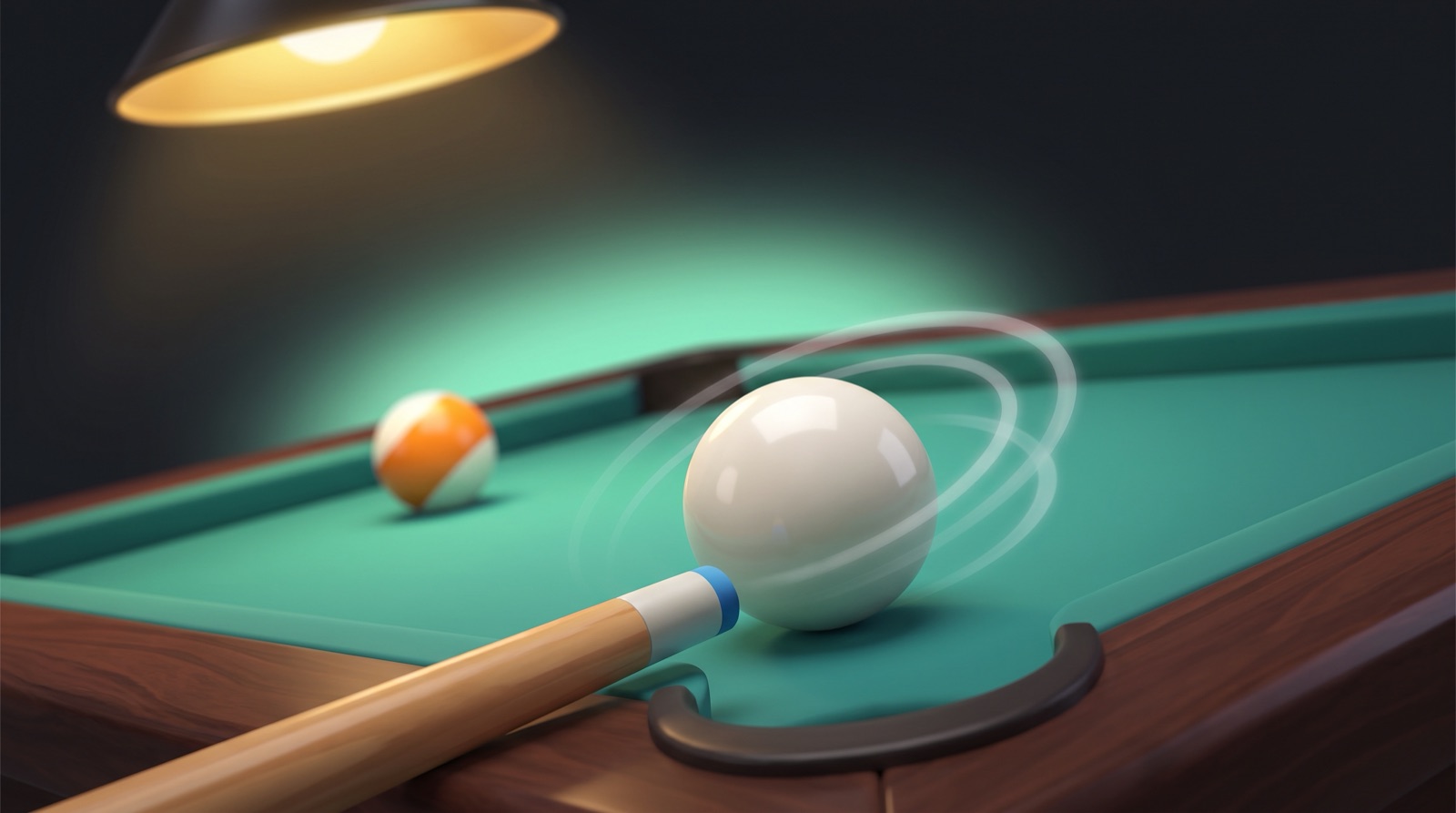
Spin comes from where the tip meets the ball, not from how hard you hit it. Strike above centre and you get follow. Strike below centre and you get draw. Strike left or right of centre and you get english. Everything else — the level cue, the chalk, the smooth stroke — exists to make that contact point land where you intended.
01
The whole mechanism in one paragraph
A cue ball is about 57 mm across, and the usable striking area is a circle roughly half a tip wide in every direction from centre; go further and the tip slides off the curve and you miscue. Every shot in pool lives inside that small window. Vertical offset decides whether the ball is rolling, sliding, or spinning backwards when it reaches the object ball; horizontal offset decides what it does at a cushion.
The cloth is the other half of the story. A cue ball struck dead centre leaves the tip sliding, not rolling, and friction spins it up until it rolls naturally — usually within a metre or so. That is why the same tip height produces completely different results at different distances, and why nearly every spin problem is really a distance problem.
Vertical tip position decides where the cue ball goes after contact; horizontal tip position decides where it goes after the rail.
02
Follow: the easiest spin, and the one you already use
Follow is topspin. Hit above centre and the cue ball is rolling forwards when it strikes the object ball, so it keeps going forwards afterwards. It is the easiest spin to produce because the cloth is on your side: any shot travelling far enough becomes a rolling ball on its own, so on long shots you are getting follow whether you asked for it or not. Hitting high just gets you there sooner.
Use it when the next ball is beyond the one you are potting, or when you want the cue ball to carry into a rail and come out to the middle of the table. The common mistake is using follow when the object ball sits near a pocket you also have to avoid — topspin makes the cue ball chase the object ball, and it will happily follow it in.
03
Draw: backspin that has to survive the journey
Draw is the reverse. Hit below centre and the ball leaves the tip spinning backwards. If it still has backspin left when it meets the object ball, it reverses and comes back towards you.
The critical word is left. Cloth friction eats backspin continuously, so one low hit produces three different shots at three distances: a full draw close in, a stop shot where the spin has just cancelled out, and a gentle follow beyond it. Nothing about your stroke changed — only the distance did.
So when draw fails, check distance first, then equipment, then mechanics. A dry or worn tip cannot grip low enough to hold spin, an elevated butt drives the cue ball down into the cloth, and decelerating into the ball takes most of the spin off before it exists. Level cue, chalked tip, accelerate through.
04
English: a rail tool, not an aiming tool
Sidespin barely changes where the object ball goes. What it changes, dramatically, is how the cue ball leaves a cushion.
Running english — sidespin turning the same way the cue ball is already travelling along the rail — grips the cushion and pushes the rebound wider and faster. Check english, sometimes called reverse, fights the cushion instead: the rebound comes back narrower and slower, and can nearly kill the cue ball on the rail. That single pair gives you most of the cue-ball routes a good player uses to cross the table and arrive somewhere useful.
It is also the last tool you should reach for. If a centre-ball hit gets you where you need to be, take it: english exists to open up positions draw and follow cannot reach, not to make ordinary shots more interesting.
05
The two costs nobody warns beginners about
Deflection. When you strike the cue ball off to one side, it does not set off along your aim line. It squirts away in the opposite direction to the english, because you pushed sideways on a heavy object with a light stick. It is predictable once you know your own cue, but it means an aim line that works for centre-ball is wrong the moment you add a tip of side.
Throw. Two balls in contact rub against each other for a fraction of a millisecond, and friction pushes the object ball a degree or two off the line pure geometry predicts. Sidespin adds throw in the direction of the spin; cut angles produce throw on their own. On a long shot into a far corner, a degree is the whole pocket.
Add sidespin only when you have a specific reason. Two costs, one benefit — make sure you are actually collecting the benefit.
06
A practice ladder that actually works
One: the stop shot. Cue ball a metre from an object ball, straight in. Hit slightly below centre, firm and level, and make the cue ball stop dead the instant it makes contact. It is the most valuable drill in pool, because it calibrates tip height, stroke and speed at once — a stop shot only works when all three are right.
Two: the same shot at two metres. You will have to hit lower, harder, or both. Feeling how much lower teaches you the rate at which the cloth eats backspin better than any explanation can.
Three: follow and draw from one position. Same straight-in shot, three in a row: stop, follow two feet, draw two feet back. Now you own the vertical axis.
Four: one rail with running english. Pot a ball, send the cue ball into a long rail, and try to land it in a target area on the far side. Then repeat the identical shot with check english and watch the rebound tighten.
07
Why a simulated table can teach this at all
Spin is the part of pool most video games quietly skip, because it is easier to move a ball along a scripted path than to model what a spinning sphere does to cloth and cushion rubber. Duel takes the harder route: a deterministic fixed-step simulation with tip-offset spin, the skid-to-roll transition, spin-aware cushion rebound and contact throw. The practical consequence is that the ladder above transfers. Hit low and long and the draw fades the way it fades on cloth; take a rail with running english and the rebound genuinely widens, because the angle falls out of the physics rather than a lookup table. It does not replace a real table, but if the nearest one is an hour away, a simulation that gets the mechanism right beats nothing.
08
Common questions
How do you put spin on a cue ball?
You put spin on the cue ball by striking it away from its centre with a chalked tip: above centre for follow (topspin), below centre for draw (backspin), and left or right of centre for english (sidespin). The useful range is roughly half a tip either side of centre, because past that the tip slides off the ball and miscues. Keep the cue as level as you can and stroke smoothly through the ball rather than jabbing at it — spin comes from where you hit, not from how hard you hit.
What is the difference between draw and follow in pool?
Follow is topspin: the cue ball is rolling forwards at contact, so it continues forwards after hitting the object ball. Draw is backspin: the cue ball is still spinning backwards at contact, so it reverses and comes back towards you. Follow is easier because the cloth turns every shot into a natural roll within a metre or so, while draw has to survive the trip — the further the cue ball travels, the less backspin is left when it arrives.
Why is my draw shot not drawing back?
The usual cause is distance: friction with the cloth kills backspin quickly, so a low hit that would draw a foot away may be a plain stop shot from two metres. The other three causes are an unchalked or badly worn tip, an elevated butt that drives the cue ball down into the cloth, and decelerating into the ball instead of stroking through it. Hit lower, keep the cue level, and accelerate smoothly through the contact point.
What does english do to the cue ball?
English is sidespin, and its main job is changing how the cue ball comes off a cushion. Running english — spin turning the same way the ball is travelling along the rail — widens the rebound and speeds it up; check or reverse english narrows the rebound and slows it. Sidespin barely changes the object ball’s path, so it is a position tool, not an aiming tool.
Does side spin make it harder to pot the ball?
Yes, and for two separate reasons. Deflection means the cue ball leaves the tip slightly off your aim line, in the opposite direction to the english you applied, so the whole shot starts wrong. Throw means the spinning cue ball rubs the object ball at contact and pushes it a degree or two off the line the geometry predicts. Neither is huge, but they stack, which is why strong players use centre-ball whenever position allows it.
What is the best way to practise spin?
Start with the stop shot: set the cue ball a metre from an object ball, hit it just below centre with a firm, level stroke, and get the cue ball to stop dead on contact. That single shot calibrates your tip height, your stroke and your speed all at once. Once a stop shot is reliable at one metre, move it back to two, then add follow and draw from the same position before you touch sidespin at all.