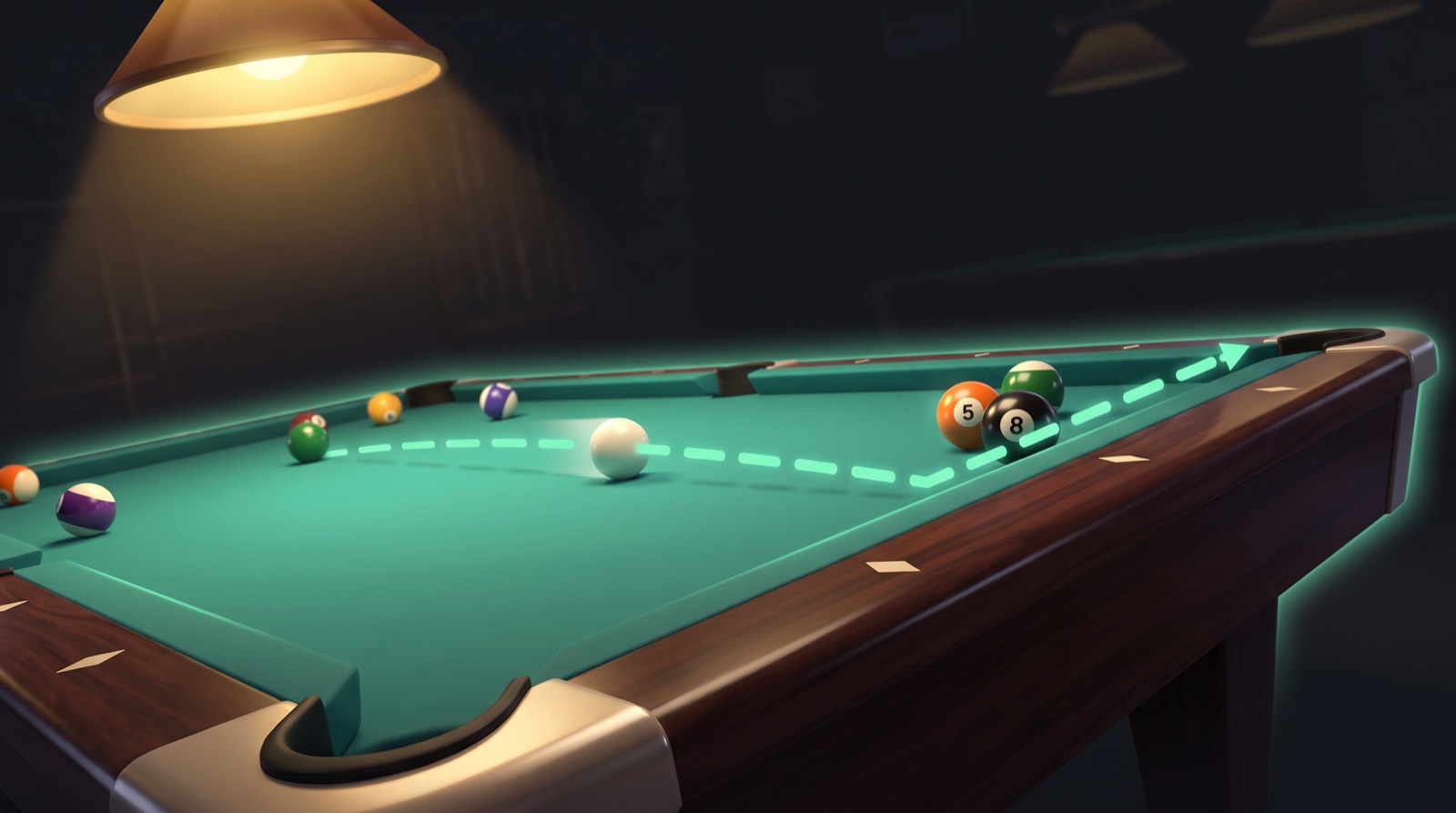
To play a kick shot, imagine the ball you need to hit reflected through the rail you intend to use — as far behind the cushion as it sits in front of it — and drive the cue ball straight at that reflection. The rail bends the path back onto the real ball. Then make sure something reaches a cushion after contact, which is the rule most players forget and the reason a good escape still ends in a foul.
01
What a kick shot actually is
A kick shot sends the cue ball into a cushion before it reaches the object ball. You use one when another ball stands between the white and the ball you must hit — being snookered, or hooked.
Separate it from its neighbours: a bank drives the object ball into a rail on its way to a pocket, a carom goes off another ball, a kick goes off a rail with the cue ball. Only the kick is primarily a rescue, which is why the target is a legal hit first and a pot a distant second.
02
The legality trap nobody warns you about
Hitting a rail before an object ball is entirely legal; nothing in 8-ball prohibits it. But the rule for a legal shot has two halves: the cue ball must first contact a ball from your group, and then either a ball must be pocketed or some ball must reach a cushion after that contact.
The rail you used on the way in does not count: it happened before contact, and the requirement is about what happens after. So a soft kick that kisses your ball and stops there is a foul, even though you hit the right ball.
Hit kicks firmly enough that the cue ball has somewhere to go after contact, or pick a line where the object ball is close enough to a rail to be nudged into one. Under-hitting is the most common way to turn a good escape into ball in hand for your opponent.
03
Aiming the one-rail kick
Use the mirror idea that governs bank shots, with the roles reversed. Pick the rail, then imagine the table continuing past that cushion, a folded-out copy of the one in front of you. Your target ball appears in that phantom half the same distance beyond the rail as it sits in from it.
Now shoot the cue ball at the reflection as though the rail were not there. You never have to name the contact point, and you never judge two angles in sequence — you make one aim at one target, which is a thing your eyes are already good at.
The diamonds make the reflection measurable. Count how many diamonds your target ball sits from the corner along the rail you are using, then count the same number past the rail in your head. The diamonds are evenly spaced for exactly this kind of arithmetic.
04
Speed shortens the angle
A cushion is rubber, not glass. Strike it hard and it compresses, and the cue ball comes out at a narrower angle than the mirror promised — the kick “shortens” and you arrive thin, on the near side of the ball. Roll into the rail gently and the rebound comes out wider, or longer.
Because you also need pace to satisfy the after-contact cushion rule, the usable range is narrow: firm, unhurried, repeatable. Pick one kick speed and learn what the table does at it.
05
Leave spin alone until the geometry is reliable
Sidespin genuinely changes a rebound — running english widens the angle off the cushion, reverse english narrows it. But it also adds squirt and swerve on the way to the rail, so two errors compound before the ball has done anything useful. Learn kicks with a centre-ball hit; once the plain path is predictable, spin becomes a tuning knob instead of a variable you are fighting.
06
When one rail cannot reach: two-rail kicks
Sometimes no single cushion opens a line. The two-rail kick solves it by mirroring twice: reflect the target through the second rail, then reflect that point through the first rail, and aim at the second reflection.
Errors double across two cushions, so treat a two-railer as a hit attempt rather than a plan. If it connects at all, you have saved a foul.
Where two kicks both reach the ball, choose the one that sends the cue ball away from the middle of the table afterwards. A legal hit that also leaves your opponent long is worth two of a legal hit that parks the white in the open.
07
Kick safe, not just kick
Most players treat a snooker as damage control and stop thinking once the hit is legal. But a kick still ends with the cue ball somewhere, so you may as well choose where. Ask which side of the object ball you would rather arrive on, and whether a slightly thicker or thinner contact tucks the white behind the same cluster that was blocking you. Escaping a snooker and handing one back is the strongest answer to being hooked.
08
How to build the calibration
Kicks are a calibration skill more than a knowledge skill. You understood the mirror in two paragraphs; what you do not yet have is a feel for how much this cushion, at your speed, shortens the angle. That only comes from shooting the same kick repeatedly and watching where it lands.
That is awkward to get in a bar, where you get one attempt before someone else wants the table. A simulator works instead, provided the physics are deterministic — the same aim and power must give the same result every time, or you cannot tell whether the kick came up thin because you hit it too hard or because the game rolled a dice. Duel runs a fixed-step simulation of cushion rebound and spin, so the identical escape at three speeds reads as three clean data points.
09
Common questions
What is a kick shot in pool?
A kick shot is when you drive the cue ball into a cushion first and use the rebound to reach an object ball you cannot hit directly. It is the standard escape from a snooker, where another ball blocks the straight path to the ball you are required to hit. Kick shots are about making a legal hit, not usually about potting.
How do you aim a kick shot?
Picture your target ball reflected through the rail you intend to use, as far behind the cushion as it sits in front of it, then shoot the cue ball straight at that reflection. The rail folds the path back onto the real ball because the cue ball leaves a cushion at roughly the angle it arrived. Aim at the reflection and ignore the rail entirely while you are down on the shot.
Is a kick shot a foul in 8-ball?
No, hitting a rail before you hit an object ball is completely legal. It becomes a foul only if the cue ball misses your group entirely, hits the wrong ball first, or if no ball reaches a cushion or a pocket after the contact. The rail you used on the way in does not satisfy that second requirement, which is what catches most players out.
What is the difference between a kick shot and a bank shot?
In a kick shot the cue ball hits a cushion before it reaches the object ball. In a bank shot the cue ball strikes the object ball directly and the object ball goes into a cushion on its way to a pocket. Kick shots are usually defensive escapes, bank shots are usually attempts to score.
Why do my kick shots always come up thin?
Speed is the usual culprit. A hard kick compresses the cushion and rebounds at a narrower angle than the mirror predicts, so the cue ball lands short of the target and slides past the thin side. Shoot kicks at a firm but unhurried pace with a centre-ball hit, and the geometry you aimed at is much closer to the path you get.
What happens if you cannot hit your ball at all?
You still have to try. There is no free pass for being snookered in 8-ball, so you play the best kick available and accept a foul if it misses. Under most rulesets the penalty is ball in hand for your opponent, so the smart move is to pick the kick that leaves the cue ball somewhere awkward even when the hit fails.