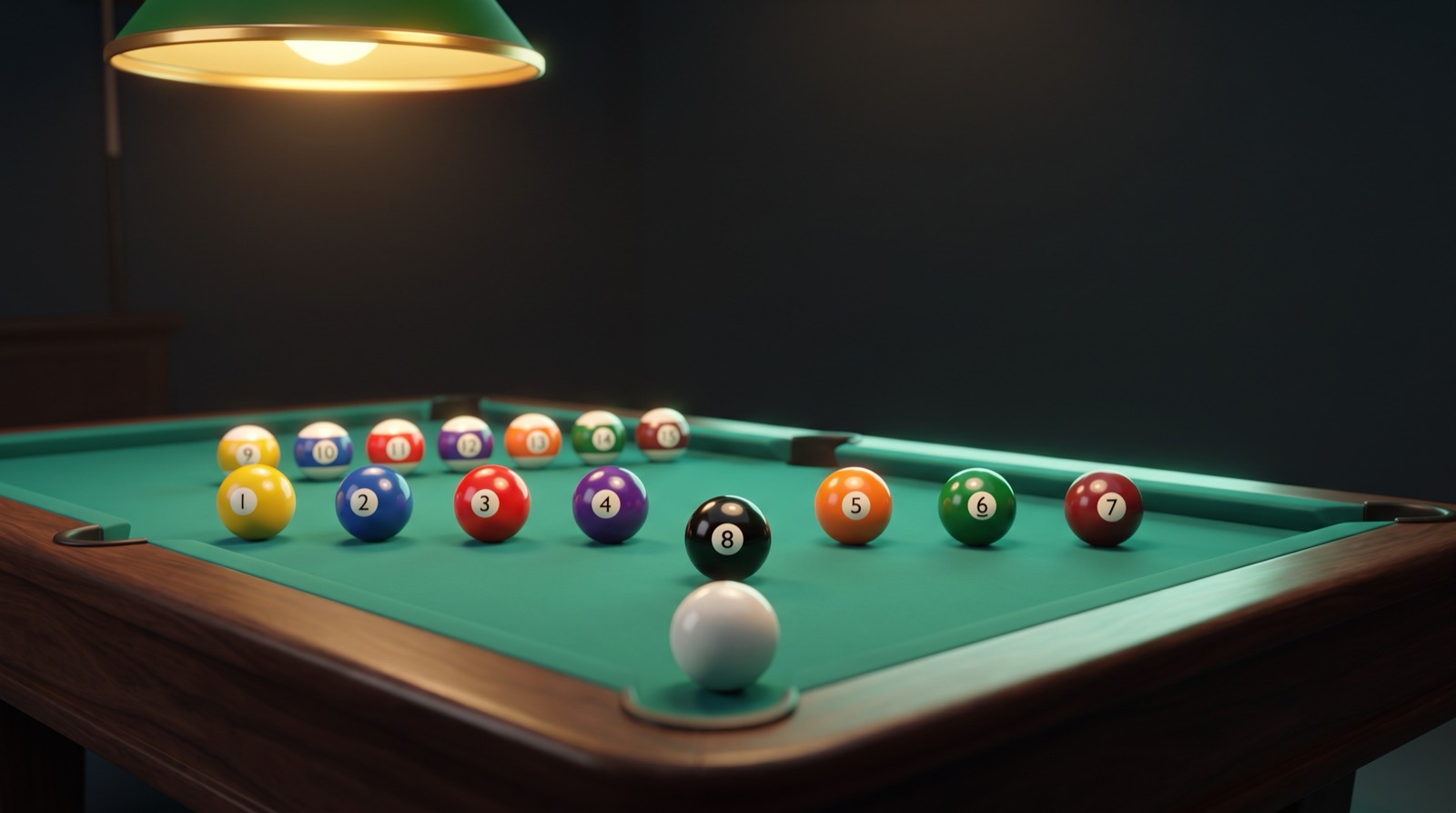
A standard set of pool balls has sixteen balls: one white cue ball and fifteen numbered object balls. Balls 1 to 7 are solid colors, the 8 is black, and balls 9 to 15 are white with a colored stripe. The colors run in a fixed order — yellow, blue, red, purple, orange, green, maroon — and every stripe wears the same color as the solid numbered eight below it. That is the whole code. The rest of this guide is the detail that makes it stick, and the small part of it the rules actually care about.
01
How many balls are in pool?
Sixteen are on the table at the start of a game of 8-ball: the cue ball plus fifteen object balls racked in a triangle. The cue ball is the only one you ever strike with the cue; the other fifteen are the targets. When you clear your seven and then the 8, the game is over with the 8 and your opponent’s remaining balls still out.
Other pool games use a subset of the same set rather than a different one. Nine-ball racks only balls 1 through 9 in a diamond, ten-ball uses 1 through 10, and straight pool uses all fifteen but ignores the groups entirely. Snooker is a separate sport with its own twenty-two ball set, and English pub pool uses reds and yellows instead of numbered solids and stripes, which we come back to below. If someone asks how many balls are in pool without naming a game, sixteen is the answer they are after.
02
The color code, and the trick to remember it
Here is the full set. Learn the seven solids and you have learned all fifteen, because the stripes are the same seven colors again in the same order.
1 yellow · 2 blue · 3 red · 4 purple · 5 orange · 6 green · 7 maroon · 8 black
Stripes 9 to 159 yellow · 10 blue · 11 red · 12 purple · 13 orange · 14 green · 15 maroon
The trick is to add eight. Whatever solid you are looking at, the stripe of the same color is that number plus eight: the blue 2 pairs with the blue 10, the green 6 with the green 14. Run it the other way when you see a stripe and want its number without reading it. A striped orange ball is 5 plus 8, so it is the 13.
Two colors cause most of the misreads. The 7 is officially maroon but looks brown, burgundy, or plain dark red depending on the set and the light, and under a warm bar lamp the purple 4 and the blue 2 can be hard to tell apart from across the table. Those are the two pairs worth a second look before you call a shot.
03
Why half the balls are striped
8-ball splits the object balls into two groups of seven, and both players need to know whose is whose from the far end of a nine-foot table. A stripe does that job better than a second set of colors would, because a band of white reads instantly even when the color itself is ambiguous. That is the entire reason the pattern exists.
The groups have nicknames that vary by room. Solids are the lows, the little ones, or the spots; stripes are the highs or the big ones. They are all the same two groups. Under standard rules the table is open after the break, and your group is settled by the first ball you pot legally after that, not by what happened to drop on the break. From then on you may only pocket your own group until it is gone, and only then the 8.
04
The 8-ball and the cue ball
The 8 is solid black with its number in a white circle, and for group purposes it is neither a solid nor a stripe. It is the last ball either player pots. Sink it before your group is cleared and you lose the game; sink it and scratch on the same stroke and you also lose.
The cue ball is plain white and unnumbered. Some tournament sets use a cue ball marked with six small red dots, the so-called measles ball, so spectators and cameras can see the spin on it. The ball plays the same; only the markings differ.
Coin-operated tables have to return the cue ball after a scratch while keeping the object balls locked away, so they use a cue ball the mechanism can tell apart: either slightly oversized or fitted with a magnetic core. An oversized, heavier cue ball follows through harder and draws back less than a regulation one. If your draw shot works at home and dies in the bar, suspect the ball before you suspect your stroke.
05
Where the colors go in the rack
The only positions that matter when racking for 8-ball are the 8 in the centre of the third row, the apex ball on the foot spot, and a solid in one back corner with a stripe in the other. Every other slot is random, and nothing in the rules says which colors sit where. Putting the yellow 1 at the front is a habit borrowed from nine-ball, where the 1 must lead the diamond; in 8-ball it is optional.
A good habit is to alternate solids and stripes around the outside of the triangle so neither group clusters together after the break. That is a courtesy and a fairness convention, not a rule, and in a league you rack the way the league tells you to.
06
What the colors mean in the rules: nothing
The rules of 8-ball never mention a color. Balls are identified by number and by group. When you call a shot you say the number and the pocket — the 3 in the corner — not the red in the corner. Fouls, legal hits, and who owns which group are all decided by number and group too. Color is a reading aid for the person standing at the table, and that is all.
The clearest proof is the television set. The ball set used on broadcast tables swaps the purple 4 and 12 for pink and the maroon 7 and 15 for a light tan, because purple and maroon are hard to separate from blue and black on camera. The numbers do not move and no rule changes. Players who switch between sets get caught out for a rack or two and then stop noticing.
Any game that enforces the rules properly, Duel included, resolves a shot by number and group, so the reliable way to read a table is to find the number first and let the color confirm it. Doing it the other way round is how a tired player pots the 11 while on solids.
07
Size and weight, and the sets that break the pattern
A regulation American pool ball is 2¼ inches across, which is 57.15 millimetres, and weighs between 5½ and 6 ounces, roughly 156 to 170 grams. All sixteen balls in a set are meant to be the same size and weight, which is part of why the oversized bar cue ball plays so differently. Modern balls are phenolic resin, which holds its roundness and colour for decades; cheaper polyester sets chip and fade.
English pool, also called blackball, is the pub game across the UK and much of Europe. It uses seven reds, seven yellows, a black, and a cue ball, all smaller at 2 inches across and with a slightly smaller cue ball again. It is still a two-group game with a black to finish, so the colors do the job stripes do in the American set, but the rules differ in several places and the two should not be confused.
Snooker uses twenty-two balls at 2 1/16 inches, about 52.5 millimetres: fifteen reds and six colors, each worth a different number of points. Snooker is the one cue sport where color is written into the rules, because the colors are the scoring. In pool the number is the ball; in snooker the color is.
08
Common questions
How many balls are in a game of pool?
A standard pool set has sixteen balls: one white cue ball and fifteen numbered object balls. In 8-ball all sixteen start on the table, with the fifteen object balls racked in a triangle. Nine-ball uses only balls 1 to 9 from the same set, and snooker is a separate sport with its own twenty-two ball set.
What are the pool ball colors in order?
The solids run 1 yellow, 2 blue, 3 red, 4 purple, 5 orange, 6 green, and 7 maroon, and the 8 is black. The stripes repeat the same sequence: 9 yellow, 10 blue, 11 red, 12 purple, 13 orange, 14 green, and 15 maroon. Every stripe shares its color with the solid numbered eight lower.
Which pool balls are solids and which are stripes?
Balls 1 through 7 are solids, with the whole ball in one color apart from a small white circle around the number. Balls 9 through 15 are stripes, which are white with a single wide band of color around the middle. The black 8 belongs to neither group and is the last ball either player pots.
Is the cue ball bigger than the other balls?
On a regulation table the cue ball is the same size as the object balls, 2.25 inches in diameter. On many coin-operated bar tables it is slightly larger or built with a magnetic core so the table mechanism can separate it from the object balls and return it to you after a scratch. A larger, heavier cue ball follows through harder and draws back less, which is why bar-table pool can feel different from a home or club table.
Why are some pool balls red and yellow instead of striped?
Red and yellow sets are used for English pool, also called blackball, which is the pub game played across the UK and much of Europe. It still splits the balls into two groups of seven plus a black, but it uses two plain colors instead of solids and stripes, and the balls are smaller at 2 inches across. The rules are also different from American 8-ball, so do not assume one set of rules covers both games.
Do pool ball colors matter in the rules?
No. The rules of 8-ball identify balls by number and by group, solid or stripe, and never by color. When you call a shot you name the number and the pocket. The colors exist to help you read the table quickly, which is why television sets sometimes swap the purple and maroon balls for pink and tan without changing a single rule.