
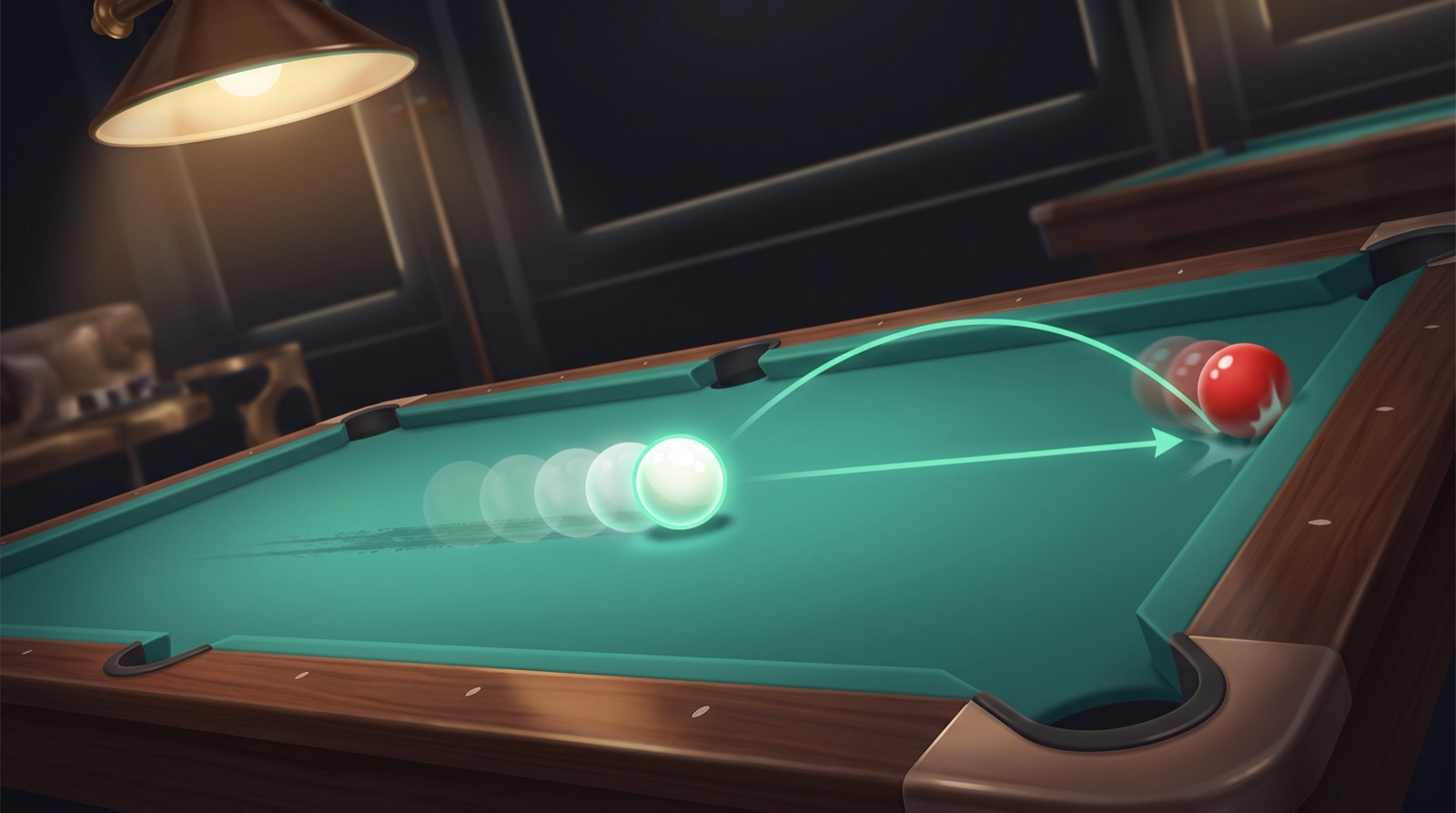
“Real physics” in a pool game means the outcome of a shot is calculated from forces, not chosen from a list of canned results. Five things have to be simulated for that to be true: the cue ball sliding before it rolls, spin that survives until contact, momentum shared between colliding balls, cushions that lose energy and grip spin, and friction between the balls themselves. Each one is also a rule of the real table, so learning them makes you a better player whether you ever touch a phone or not.
01
Every shot starts with a slide
A cue tip meets the ball well above the cloth, so the ball leaves the tip travelling forward faster than it is turning. For a moment it skids. Cloth friction acts on the tiny patch where ball meets table, and that friction does two jobs at once: it slows the ball and it twists it forward. When the spin catches up with the speed, the slide ends and the ball rolls naturally.
The numbers behind this are well established. Sliding friction on billiard cloth is roughly 0.2, while rolling resistance is closer to 0.01 — about twenty times smaller. That gap is why a ball skids only briefly and then rolls a long way. For a centre-ball hit, the ball comes out of the slide rolling at about five sevenths of the speed it started with.
Draw, follow, and stun are all decided by what the cue ball is doing at the instant it arrives. A stun only stuns while the ball is still sliding, which is why the same stop shot dies close up and rolls through from across the table.
02
Spin is set by where the tip lands
Hit above centre and the ball starts with extra forward spin; hit below and it starts spinning backwards. Hit left or right and you add spin around the vertical axis, which players call english. The further from centre, the more spin, up to about half the ball’s radius — beyond that the tip slips off and you miscue.
Top and bottom spin are fighting the cloth from the moment the ball leaves the tip. Backspin is being worn away the entire time the ball travels, so a draw shot from distance needs both a lower hit and more pace to arrive with anything left. Side spin decays too, but more slowly, because it is not rubbing against the direction of travel. A believable simulation has to wear down each kind of spin at its own rate.
03
The 90 degree rule and the 30 degree rule
Pool balls are almost identical in mass and nearly perfectly elastic, with a coefficient of restitution around 0.93 to 0.96. That produces two of the most useful rules in the game.
The 90 degree rule. A cue ball that is sliding with no spin hands its momentum along the line through the two centres. The object ball leaves along that line; the cue ball leaves along the tangent line, at right angles to it. Every stun shot and every position play off a sliding ball is built on this split.
The 30 degree rule. A rolling cue ball carries forward spin through the collision. It still starts off along the tangent line, but that spin grips the cloth and bends it forward. Across a wide band of cuts, from roughly quarter-ball to three-quarter-ball, it ends up about 30 degrees from its original line. Hold your hand in a V to estimate it, and you can predict the cue ball on most ordinary shots without thinking.
04
Throw: why perfect aim still misses
Balls are not frictionless. During the tiny fraction of a second they are in contact, the cue ball’s surface rubs across the object ball’s surface and drags it slightly sideways. On a cut shot that pushes the object ball a little toward the direction the cue ball was travelling, so soft cuts land a touch thick. Side spin can add to this effect or cancel it.
Throw is small, usually a degree or a few, but a degree over a long pot is the difference between the middle of the pocket and the jaw. A game that leaves it out will teach you a slightly wrong aim, and you will feel the difference the first time you play on real cloth.
05
Cushions are not mirrors
A perfect mirror would send a ball away at exactly the angle it arrived, at exactly the same speed. Real rails do neither. They give back somewhere between about 60 and 90 per cent of the incoming speed, and the harder the ball hits, the more energy the rubber soaks up. That is why a firmly struck bank comes off shorter than the geometry on paper says it should.
Cushions also grip. The rubber contacts the ball above its equator, so side spin rubs against the rail and changes the rebound angle: running english widens it, reverse english narrows it. Kick shots and two-rail position routes only work because of this. If english does nothing off a rail in a game, the cushions are being faked.
06
The effects most games leave out
Two effects separate a thorough simulation from a very good one. Squirt is the small amount the cue ball veers away from your aim line when you use side spin, because the tip pushes it off-centre. Swerve is the curve that follows when an elevated cue drives spin into the cloth. Both are real and both matter to advanced players, but they are hard to present fairly on a touch screen, and plenty of good games choose not to model them.
That is a legitimate choice, as long as it is disclosed. The same goes for deliberate tuning: larger balls for readability, slightly forgiving pockets, softened throw. None of it is cheating. What matters is that the rules are the same for every player and on every shot.
07
Determinism: the part you cannot see
One property matters more than any individual effect. The same shot, struck with the same aim, power, and spin from the same position, should produce exactly the same result every time. That is only possible if the simulation advances in fixed time steps rather than following the device’s frame rate, which varies from phone to phone and from second to second.
Duel steps its table at a fixed 1/120 of a second, simulating slide-to-roll friction, tip-offset spin, spin-aware cushions, and contact throw. It is also candid about what it tunes: balls drawn larger than regulation for readability, throw scaled down on thin cuts, and no squirt or swerve. Determinism is what makes practice meaningful. If a shot can come out differently for no reason, you are learning the random number generator, not the table.
Replay an identical shot twice and compare. Play a stun shot short and long. Bank a ball with and without side spin. Cut a slow ball thin and see whether it lands a little thick. Four minutes, and you will know whether you are playing physics or an animation.
08
Common questions
What does real physics mean in a pool game?
It means the game simulates the forces that decide a shot instead of scripting the outcome. At minimum that is the cue ball sliding before it rolls, spin that changes what happens after contact, momentum shared between balls on impact, cushions that lose energy and respond to side spin, and friction between the balls. If draw, follow, and stun behave differently at different distances, the physics is doing the work.
Why does the cue ball slide before it rolls?
A cue strikes the ball above the cloth, so the ball leaves the tip moving forward faster than its spin can keep up with. Friction from the cloth then drags on the contact patch, slowing the ball while turning it forward, until the spin matches the speed and it rolls naturally. For a centre-ball hit that happens within a short distance and leaves the ball rolling at about five sevenths of its starting speed.
What is the 90 degree rule in pool?
When a cue ball that is sliding with no spin hits an object ball, the two balls separate at roughly 90 degrees. The object ball travels along the line through the centres at impact and the cue ball leaves along the tangent line. It is the reason a stun shot is so predictable, and it only holds while the cue ball is still sliding at contact.
What is the 30 degree rule in pool?
When a naturally rolling cue ball hits an object ball anywhere between about a quarter-ball and three-quarter-ball contact, it deflects roughly 30 degrees away from its original line. The forward roll bends the cue ball back toward the direction of travel after it leaves the tangent line. Players use it to predict where the cue ball goes on ordinary rolling cut shots.
How can you tell if a pool game has fake physics?
Set up the same shot twice and play it with the same aim and power; if the result changes, randomness is being injected. Then check whether a soft stun and a hard stun from long range behave differently, whether side spin changes the angle off a cushion, and whether slow cuts land slightly thick. A game that gets all four right is simulating, not animating.