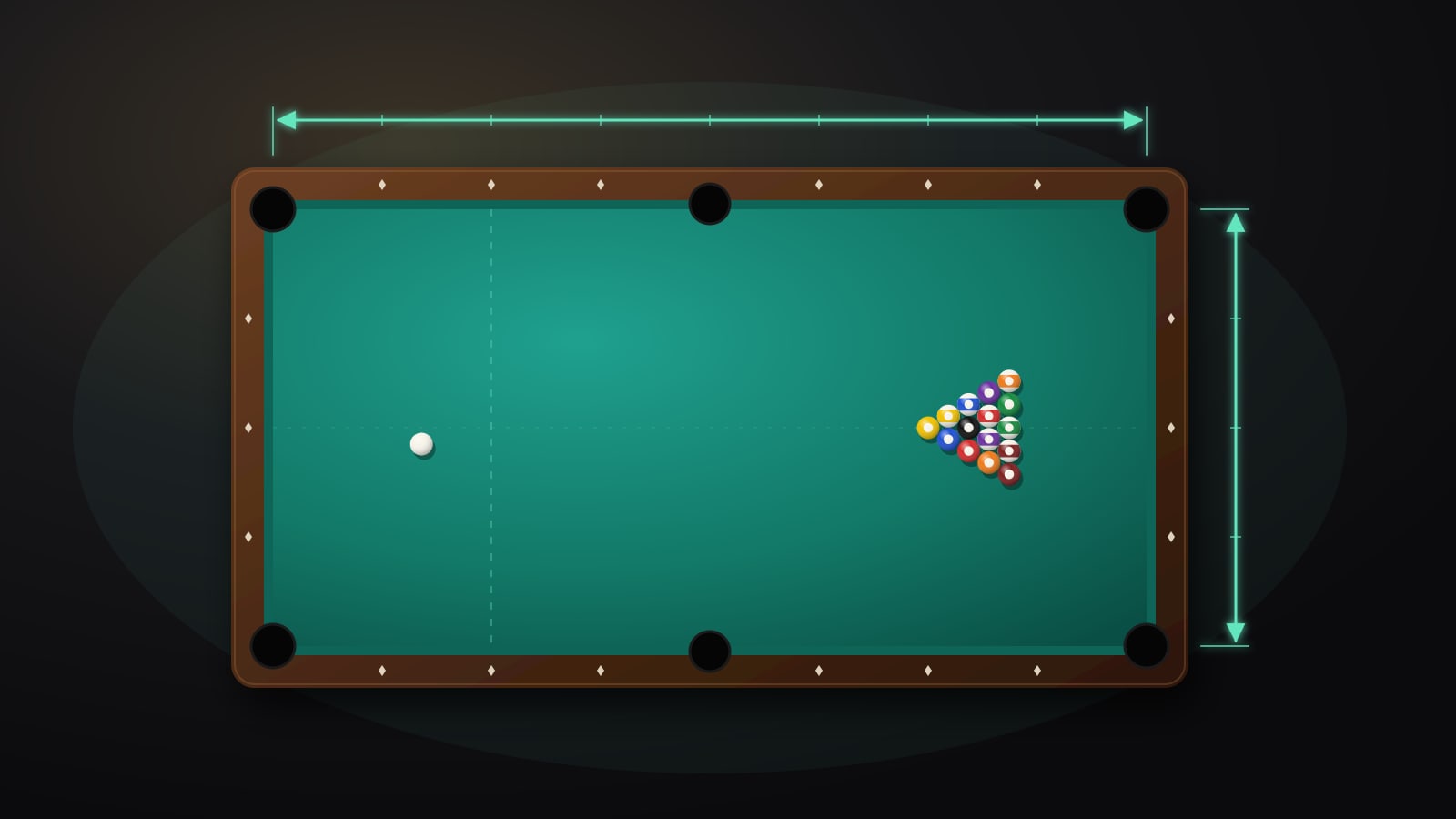
A regulation 9-foot pool table has a playing surface of 100 by 50 inches. An 8-foot home table is 88 by 44 inches, an oversized “pro 8” is 92 by 46, and a 7-foot bar table is usually 78 by 39. Every one of them is exactly twice as long as it is wide, and to play it comfortably you need about a cue’s length of clear floor on every side. The rest of this guide covers the numbers that sit behind those headlines: outside size, height, pockets, diamonds, and room.
01
The four sizes, by playing surface
The only measurement that matters for play is the playing surface: the cloth between the noses of the cushions, where the balls actually touch the rail. This is what governing bodies specify and what decides how long every shot is.
- 9-foot (regulation, tournament): 100 × 50 in (254 × 127 cm).
- 8½-foot (“pro 8” or oversized 8): 92 × 46 in (234 × 117 cm).
- 8-foot (standard home): 88 × 44 in (224 × 112 cm).
- 7-foot (bar box): usually 78 × 39 in (198 × 99 cm), with some coin-operated tables a couple of inches shorter.
Notice the shape never changes. Each table is a pair of squares laid side by side, which is why the side pockets sit exactly halfway down the long rail and why a bank shot that works on a bar box works on a tournament table too. Only the distances grow.
02
Why a 9-foot table isn’t 9 feet long
Table sizes are names, not measurements. The 9-foot table’s playing surface is 100 inches — roughly 8 feet 4 inches. Add the rails, which typically run five to seven inches wide on each side, and the outside of the table comes to a little over 9 feet long and around 5 feet wide. The same logic applies down the range: an 8-foot table is about 7½ feet of cloth inside a frame that is roughly 8 feet long.
This matters in two situations. When you compare tables online, a listing that says “8 ft” may mean the class, the cloth, or the frame, so ask for the playing surface in inches. And when you plan a room, the outside dimensions decide whether it fits through the door, while the playing surface decides how much space you need around it.
To check a table yourself, run the tape from the tip of one cushion to the tip of the opposite cushion, not from the edge of the wooden rail. That number is the real size, and it should come out at very close to exactly twice the width.
03
Height, slate, and cushions
The playing surface sits 29¼ to 31 inches off the floor, measured to the top of the rail. That is a little below most kitchen counters, and it is set so that an adult can bend into a stance with the cue level. A table that is too low forces you to hunch, which drags the cue down and puts unwanted spin on the ball.
Underneath the cloth, better tables use slate about an inch thick, normally in three pieces levelled and joined so the seams cannot be felt. Slate is why proper tables are heavy — several hundred pounds is normal — and why they stay flat for decades. Cheaper tables use composite boards that are lighter but can sag.
The cushion nose sits at about 63 to 64 per cent of the ball’s height above the cloth, about 1.4 inches for a standard ball. That height is not arbitrary: it is where the rubber strikes the ball just above its centre, so a ball rebounds cleanly instead of hopping or being pinched down into the cloth.
04
Pockets and balls: the margin you are playing with
A standard pool ball is 2¼ inches (57.15 mm) across. Under World Pool-Billiard Association specifications, a corner pocket measures 4½ to 4⅝ inches across the mouth and a side pocket 5 to 5⅛ inches. So a corner pocket is only about two balls wide, and the side pocket a little more.
The side is cut wider for a reason. A ball travelling into a corner pocket can approach along a wide spread of angles, while a ball heading into a side pocket has to arrive close to straight on. The extra width keeps side-pocket shots from being punishing at any angle.
Bar boxes and many home tables cut their pockets a touch more generously, which is a large part of why a player who dominates the local bar can find a tournament table humbling. The cloth is longer, and the target is smaller.
05
Diamonds, strings, and spots
The inlaid diamonds on the rails are a measuring system. They divide the long rails into eighths and the short rails into quarters of the playing surface, giving six diamonds on each long rail and three on each short one. On a 9-foot table they sit 12½ inches apart. Because the table is two squares, the spacing is the same on every rail, which is what makes diamond-counting systems for bank and kick shots possible.
Two of those positions define the game’s key lines. The head string runs across the table at the second diamond from the head rail, a quarter of the way down. You break from behind it, and after certain fouls ball in hand is restricted to the area behind it. The foot spot sits the same distance from the other end, on the centre line, and it is where the apex ball of the rack goes.
Since everything scales with the playing surface, these marks move with the table. On a 7-foot bar box the head string is under 20 inches from the cushion; on a 9-foot table it is 25.
06
How much room you need
The rule is simple: leave a full cue length of clear floor beyond every cushion, so twice the cue length gets added to both the length and the width of the playing surface. That lets you stand at the rail and shoot a ball frozen to the opposite cushion without the butt of the cue hitting a wall. With a standard 58-inch cue, the minimum room is:
- 9-foot table: about 18 ft × 13 ft 10 in.
- Pro 8: about 17 ft 4 in × 13 ft 6 in.
- 8-foot table: about 17 ft × 13 ft 4 in.
- 7-foot table: about 16 ft 2 in × 12 ft 11 in.
Those numbers assume clear walls. Furniture, radiators, and doorways eat into them, so add a few inches wherever something sticks out. If the room comes up short, a 52-inch cue saves a foot in each direction and a 48-inch cue saves about 20 inches. Keeping one short cue in the rack for the tight side is more practical than buying a smaller table.
If the room fits a 9-foot table, buy it: you will be learning on the table competitions use. If it fits only an 8-foot, that is still a proper table with identical geometry. Squeezing in a bigger table than the room allows is the one choice that makes every game worse.
07
Does table size change how you play?
Yes, in measurable ways. On a bigger table every shot is longer, so small aiming errors grow into bigger misses at the pocket, and you need more speed to move the cue ball the same fraction of the table. Clusters are easier to avoid because there is more room, but position play is harder because the target areas are further apart.
On a bar box the opposite happens: balls collide more often, the break spreads the rack into traffic, and safety play matters more because there is less space to hide anything. Players who move up a size usually find their potting drops for a few weeks until their speed control recalibrates.
On a phone the screen is the same size whatever the table, so the proportions are what carry the feel. Duel models a 9-foot table at its regulation 2-to-1 proportions, so the angles you learn there are the angles of a real tournament table.
08
Common questions
What are the dimensions of a regulation pool table?
A regulation pool table is a 9-foot table with a playing surface of 100 by 50 inches (254 by 127 cm), measured between the noses of the cushions. The surface sits 29¼ to 31 inches off the floor. With the rails included, the outside of the table is usually around 9 feet 4 inches by 5 feet, depending on the manufacturer.
What size is a standard home pool table?
The most common home table is an 8-foot table with a playing surface of 88 by 44 inches. Some manufacturers also make a slightly larger "pro 8" at 92 by 46 inches. Both keep the same 2-to-1 shape as a tournament table, so the angles play the same, only shorter.
How much room do you need for a pool table?
Add one cue length of clear floor beyond every cushion, which means adding twice the cue length to both the length and the width of the playing surface. With a standard 58-inch cue that means about 18 feet by 13 feet 10 inches for a 9-foot table, 17 feet by 13 feet 4 inches for an 8-foot table, and 16 feet 2 inches by 12 feet 11 inches for a 7-foot bar table. A 52-inch or 48-inch short cue lets you get away with a foot or more less in each direction.
Why is a 9-foot pool table not actually 9 feet long?
The name is a nominal size class, not a measurement. The playing surface of a 9-foot table is 100 inches, about 8 feet 4 inches, and the outside of the table including rails is usually a few inches over 9 feet. When you shop or plan a room, always ask for the playing surface and the outside dimensions separately.
How big are pool table pockets?
Under World Pool-Billiard Association specifications, corner pockets measure 4½ to 4⅝ inches across the mouth and side pockets measure 5 to 5⅛ inches. A pool ball is 2¼ inches wide, so a corner pocket is only about two balls across. Bar tables and home tables are often cut a little wider, which is one reason they feel easier.