
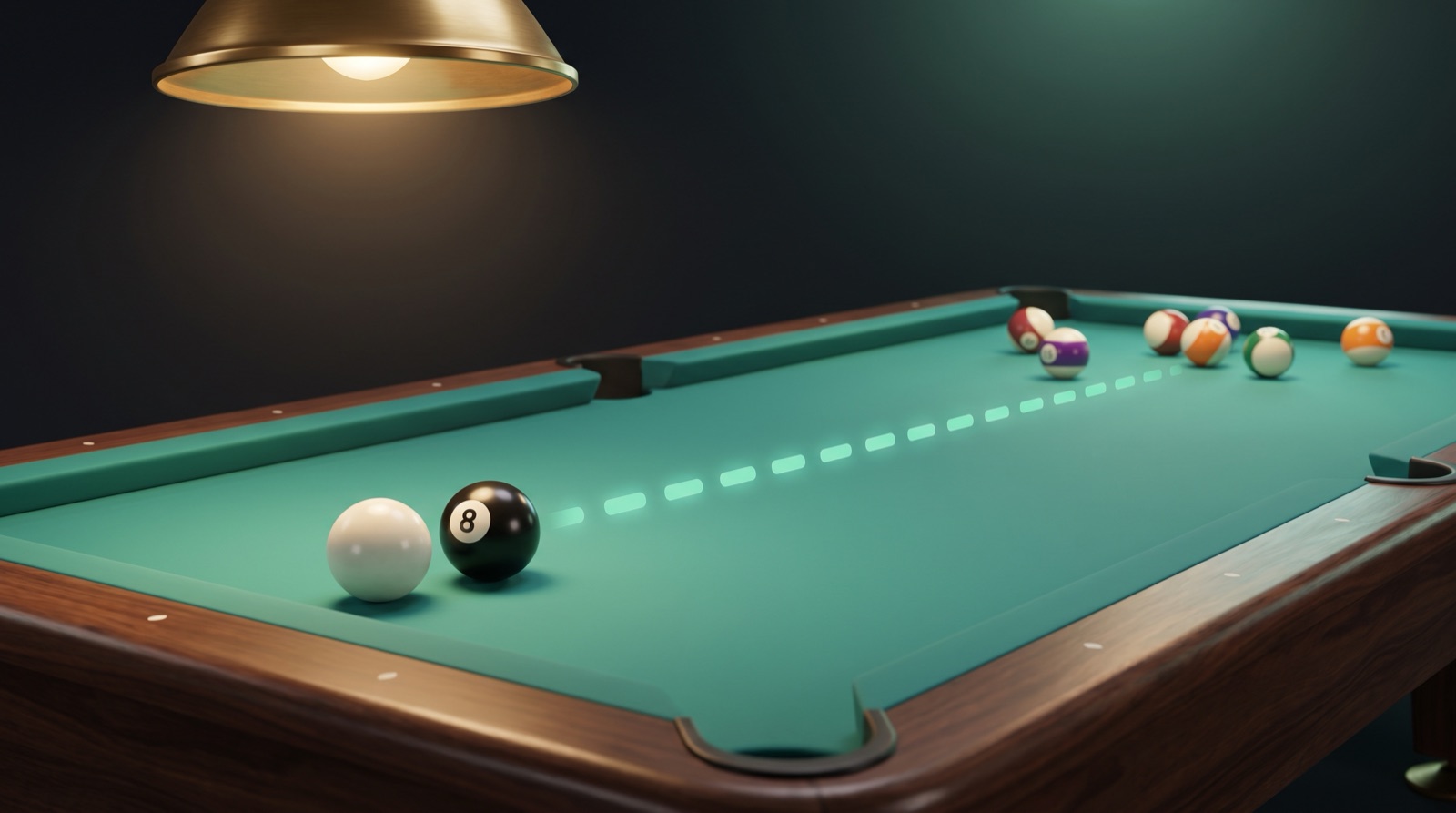
A safety is a shot you play on purpose without trying to pot anything. Make a legal hit — your own ball first, then a pocket or a cushion — and finish with the cue ball somewhere useless to your opponent: hidden behind a blocker, tight on a rail, or a full table length from the nearest ball they own. Played well it wins you the table back with interest, because their reply is a foul and your reply to that is ball in hand.
01
Two shots at every turn, not one
Most players arrive at the table and ask one question: which ball can I make? That question has a bad habit of returning a bad answer with confidence. The stronger habit is to ask two questions in order. Can I pot a ball and arrive somewhere I can pot the next one? If not, what is the worst place I can leave the cue ball while still shooting legally?
Missing a pot is not neutral. It usually gives your opponent an open table with the balls conveniently spread by your own attempt. A safety converts that same turn into a problem you hand over instead of a present. The scoreboard does not record it, but over a rack it is often the single biggest swing available to you.
02
A safety is still a legal shot
Nothing about playing safe suspends the rules. The cue ball must contact a ball from your group first, and after that contact either a ball must be pocketed or some ball — any ball, including the cue ball — must reach a cushion. This second half is where soft safeties die. You nudge your ball, everything stops in the middle of the table, and you have fouled while trying to be clever.
The fix is to plan the cushion into the shot from the start. Either the cue ball travels to a rail on its way to its hiding place, or you pick an object ball close enough to a cushion that a gentle contact rolls it there. Decide which one is doing the job before you get down.
In call-shot games, announce “safety” before you shoot. It declares that you are not claiming a pot, so the turn passes even if a ball happens to drop. Skipping the announcement in a friendly game is how arguments start.
03
When to play safe
There is a rough threshold worth internalising: if you would not back yourself to make this shot one time in two, and a miss leaves the table open, the safety is mathematically the better shot even though it feels passive.
Four situations should trigger it almost automatically. First, when your only pot is long, thin, or blocked. Second, when your group is welded into a cluster you cannot break open without giving up position. Third, when your opponent has fewer balls left than you do — trading turns is losing, so change the currency. Fourth, when the pot is easy but the cue ball has nowhere to go afterwards, and you would be potting your way into a dead end.
The mirror of this is knowing when not to. If you are on the last two balls and your position is good, take the run. Safeties are for turns you cannot convert, not for turns you are nervous about.
04
What actually makes a safety good
Three things, in this order of reliability.
Distance. The most underrated safety in pool is simply leaving the cue ball at one end of the table and every ball your opponent owns at the other. No hiding required. Long shots miss, and a missed long shot usually leaves the cue ball somewhere convenient for you. Distance is also the easiest thing to control, because you only need to be approximately right.
Obstruction. Hide the white behind one of your opponent’s balls, or the 8, or a cluster. Now they must kick off a cushion, which is a low-percentage shot for most players and a likely foul for the rest.
Angle. Even without a blocker, leaving the cue ball frozen or nearly frozen to a rail removes their ability to use draw or follow properly, because they cannot get the cue level behind the ball. A rail-hugging cue ball is a real handicap, and it costs you nothing to aim for one.
You rarely get all three. Long and awkward beats hidden and close to a ball they can nudge free. Judge a safety by how many reasonable replies it leaves, not by how clever it looks.
05
Choose the blocker before you choose the shot
Beginners play a safety by hitting a ball softly and hoping. The habit that replaces it is backwards planning. Look at the table and pick the ball you want the cue ball to end up behind, then work out what contact and what speed puts it there.
The mechanics you need are already familiar from position play. A thin contact deflects the cue ball far along the tangent line; a nearly full contact stops it almost dead. So the fullness of your hit is your distance dial, and the speed is your fine adjustment. If the hiding place is close to where the cue ball already sits, hit fuller and softer. If it is across the table, take a thinner contact and let the white run.
Prefer blockers near a cushion. A ball in the open leaves your opponent two ways round it; a ball on the rail leaves one, and a ball in the jaws of a pocket can leave none at all.
06
The safeties worth learning first
The thin-cut roll. Clip the edge of your object ball so it barely moves, and let the cue ball carry on into a distant rail and die there. Legal, simple, and it satisfies the cushion requirement automatically. This is the workhorse.
The full-hit stop. Hit your ball almost dead full at a gentle pace so the cue ball stops nearly where it stood while your object ball rolls away into a cushion. The travelling object ball supplies the legality; the cue ball stays put, so use this one when the white is already somewhere your opponent will hate.
The two-way shot. The most valuable of the three. Pick a pot you might make, but choose a line where a miss sends the cue ball somewhere terrible for your opponent anyway. You are not choosing between attack and defence; you are refusing to choose. Long cut shots down a rail are the classic candidate.
07
The ways safeties backfire
Under-hitting is the first. Nothing reaches a cushion, you foul, and your opponent gets ball in hand next to whatever you were protecting — strictly worse than an honest missed pot.
Leaving a blocker they can hit is the second. If the ball you hid behind is one of theirs, check that a thin contact on it does not also solve their problem. Hiding behind a ball your opponent is legally allowed to strike is not a snooker at all.
Forgetting the count is the third. Three consecutive fouls by the same player loses the game outright under the three-foul rule, and a long exchange of mutual safeties with no progress can be called as a stalemate and re-racked. Both rules exist precisely because safety battles can otherwise run forever.
08
How to practise something that has no scoreboard
Safeties are hard to practise because you cannot tell a good one from a lucky one in a single attempt. The measure is not whether your opponent fouled; it is how many acceptable replies you left on the table. That only becomes visible when you can play the same position more than once.
Set the same layout up repeatedly and try three different safeties from it, then look honestly at each result and count the escapes. A simulator makes this practical, provided its physics are deterministic — the same contact and speed must produce the same leave every time, or you are measuring the game’s randomness rather than your own choices. Duel runs a fixed-step simulation for exactly that reason, which turns a repeated safety into a comparison instead of an anecdote.
09
Common questions
What is a safety in pool?
A safety is a shot you play with no intention of potting, where the goal is to leave your opponent without a shot. You still have to make a legal hit — contact one of your own balls first, and then either pocket a ball or drive some ball to a cushion. A good safety ends with the cue ball hidden behind a blocker or a long way from anything your opponent can use.
Is playing safe legal in 8-ball?
Yes. Deliberately not potting is entirely legal in 8-ball as long as the shot itself is legal. In call-shot rulesets you should say “safety” out loud before you shoot, because that tells your opponent you are not claiming a pot and hands the table over even if a ball happens to drop.
When should you play a safety instead of shooting?
Play safe when the shot in front of you is under about a fifty per cent chance and missing would leave your opponent an easy start. Also play safe when you have more balls left than they do, when your group is tied up in a cluster you cannot open yet, or when potting the ball available would strand the cue ball with nothing to follow. The question is never just “can I make this” but “what happens to the table if I don’t”.
How do you hide the cue ball behind a ball?
Pick the blocker before you pick the shot, then work out the contact and speed that parks the white directly behind it. Thin contacts move the cue ball a long way and thick contacts barely move it, so choose the fullness that delivers the distance you need, and use a blocker that is close to the cue ball’s resting spot rather than one across the table. A ball sitting near a cushion makes the best screen because it removes half the escape routes.
What is the difference between a safety and a snooker?
A safety is the shot; a snooker is one possible result of it. You have snookered your opponent when no straight path exists from the cue ball to any ball they are allowed to hit, forcing them to kick off a cushion. A safety that simply leaves them a very long, very thin shot is still a good safety even though it is not a snooker.
Can you lose the game by playing safe?
You can, in two ways. Under the three-foul rule, three consecutive fouls by the same player lose the game, so a run of failed safeties is dangerous once you have been warned. Repeated safeties by both players with no progress also trigger the stalemate rule, which ends in a re-rack rather than a win for either side.