
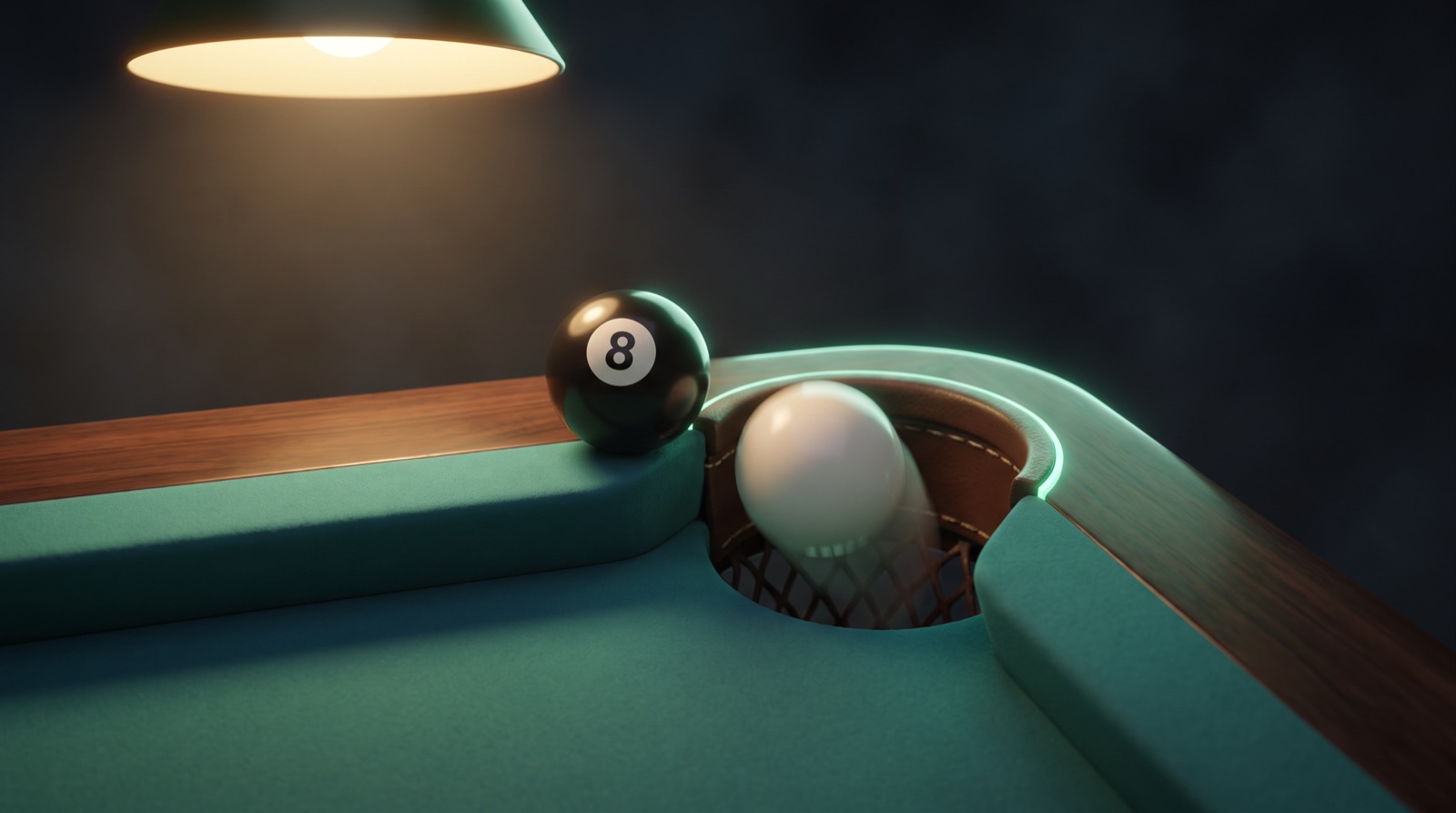
Scratching on the 8-ball loses you the game only if the 8-ball drops on the same shot. If the 8 stays on the table and the cue ball goes down, it is an ordinary foul: your opponent takes ball in hand and the rack carries on. That single distinction is the most commonly misplayed rule in 8-ball, and getting it wrong hands away games nobody actually lost.
01
The rule in one line
Under the official rules published by the World Pool-Billiard Association and the Billiard Congress of America, you lose the game if you pocket the 8-ball and scratch on the same stroke. The 8-ball and the cue ball going down together is a loss of game, full stop. There is no version of the rule where the 8 is respotted and you play on.
Every other scratch is a normal foul. Miss the 8-ball and pocket the cue ball, or rattle the 8 in the jaws and scratch, and the result is the same: ball in hand, game continues. The 8-ball is only fatal when it leaves the table.
Look at where the 8-ball is when the balls stop rolling. Still on the cloth? It was just a foul. In a pocket, or on the floor? You lost.
02
Why so many players believe otherwise
Almost everyone learns pool on a coin-op table with rules passed down by whoever was there first. The most widespread house rule in the world is that any scratch while shooting at the 8-ball loses the game, on the theory that the 8-ball shot is sudden death. It is a coherent rule and plenty of leagues use it. It is simply not the published one.
The difference matters because it changes how you play the final shot. If a scratch on the 8 costs you the match, you play the last ball slowly and defensively, accepting a difficult angle to keep the cue ball away from a pocket. If a scratch is only a foul, you can strike the 8-ball firmly and take the higher-percentage pot.
Agree which set you are playing before the break. It takes five seconds and removes the only genuinely bitter argument in casual pool.
03
The break is the exception
Pot the 8-ball on the break and you do not lose, even though the 8 went down. Under BCA rules the incoming player picks one of two outcomes: re-rack and break again, or spot the 8-ball on the foot spot and shoot from where the cue ball lies. Add a scratch to that break and the choice narrows a little: the incoming player may re-rack, or spot the 8-ball and take ball in hand behind the head string.
The exception exists because sinking the 8 on the break is mostly luck, and punishing a coin flip makes for a worse game. Some leagues do award an instant win for a clean 8-on-the-break, which is another rule worth settling in advance.
04
Every way the 8-ball can end the game against you
A scratch is only one of them. The complete list under official rules is short and worth memorising:
You pocket the 8-ball and scratch on the same shot. Immediate loss, regardless of whether the 8 went into your called pocket.
You pocket the 8-ball before clearing your group. Loss. A stripe player with one stripe left who accidentally drops the 8 has lost, no matter how good the shot was.
You pocket the 8-ball in a pocket you did not call. Loss. This is why nominating the pocket matters even when the shot looks obvious, and why a cross-corner that ends up going cross-side is a loss rather than a lucky win.
You drive the 8-ball off the table. Loss, at any point in the game. An object ball of your own leaving the table is merely a foul, so the 8 asks for a gentler stroke than everything else on the cloth.
You foul on the 8-ball shot and the 8 goes down. Hitting one of your opponent’s balls first and then potting the 8 is a loss under the same clause, because the pot was not legal.
05
How to not scratch on the black
Most 8-ball scratches are position mistakes made one shot earlier. As you pot your final group ball, you are choosing the angle you will face on the 8: pick one where the cue ball’s natural path after contact runs into open cloth, not toward a pocket.
On the shot itself, three habits carry most of the weight. First, use a slower stroke than feels necessary; the 8-ball only has to reach the pocket, and the cue ball travels less the softer you hit. Second, favour a touch of draw or a stun stroke on straight shots, because follow is what carries the cue ball forward into the same pocket the 8 just entered. Third, when the pot and the position are in conflict, take the safety instead. There is no clock, and a returned safety is infinitely cheaper than a scratch on the black.
The classic disaster is a straight-in 8-ball down the rail hit with a firm follow-through: the 8 goes in, the cue ball follows it, and the game is over. Slow it down and the same shot is routine.
06
Drilling it without an argument
Set the 8-ball in the common last-ball positions—straight in on a rail, a thin cut into the corner, a long shot down the table— and play each one until you can pot it without moving the cue ball more than a couple of feet.
A simulator helps here mainly because it never negotiates. In Duel, pocketing the 8 while the cue ball scratches ends the game immediately in the opponent’s favour, and a scratch with the 8 still on the table is scored as an ordinary foul with ball in hand—the official behaviour rather than the bar version. Calling the pocket on the 8-ball is always required; an optional tournament ruleset extends calling to every shot.
07
Common questions
Do you lose if you scratch on the 8-ball?
You lose only if the 8-ball is pocketed on the same shot as the scratch. Under the official WPA and BCA rules, pocketing the 8 and the cue ball together is an immediate loss of game, with no reprieve. If the 8-ball stays on the table and you simply scratch while shooting at it, that is an ordinary foul: your opponent takes ball in hand and the game continues.
What happens if you scratch while shooting at the 8-ball but do not pot it?
It is a standard foul and nothing more. Your turn ends and your opponent receives ball in hand anywhere on the table, exactly as they would after any other scratch. Many bar players believe this loses the game, but no major published ruleset says so.
What if you pot the 8-ball and scratch on the break?
You do not lose on the break. Under BCA rules the incoming player chooses either to re-rack and break, or to spot the 8-ball and take ball in hand behind the head string. The scratch is still a foul, so the shooter does not continue either way.
Do you lose if the 8-ball goes in the wrong pocket?
Yes. Once you are on the 8-ball you must nominate a pocket, and dropping the 8 anywhere else is a loss of game even if you did not foul otherwise. The same applies if the 8-ball is pocketed early, before you have cleared your group. Calling the pocket out loud before the stroke is what protects you.
What happens if you knock the 8-ball off the table?
Driving the 8-ball off the table is a loss of game under the official rules, whether or not you were shooting at it. It is treated the same way as pocketing it illegally. An object ball from your own group jumped off the table is only a foul, which is why the 8 deserves a softer stroke than everything else.
Is scratching on the 8-ball a loss in bar rules?
In many bar and house rulesets, yes: any scratch while shooting at the 8-ball loses the game even if the 8 stays up. This is the single biggest gap between tavern rules and official rules, and it is decided at the table rather than in a rulebook. Ask before the break, because arguing about it after the cue ball drops never ends well.