
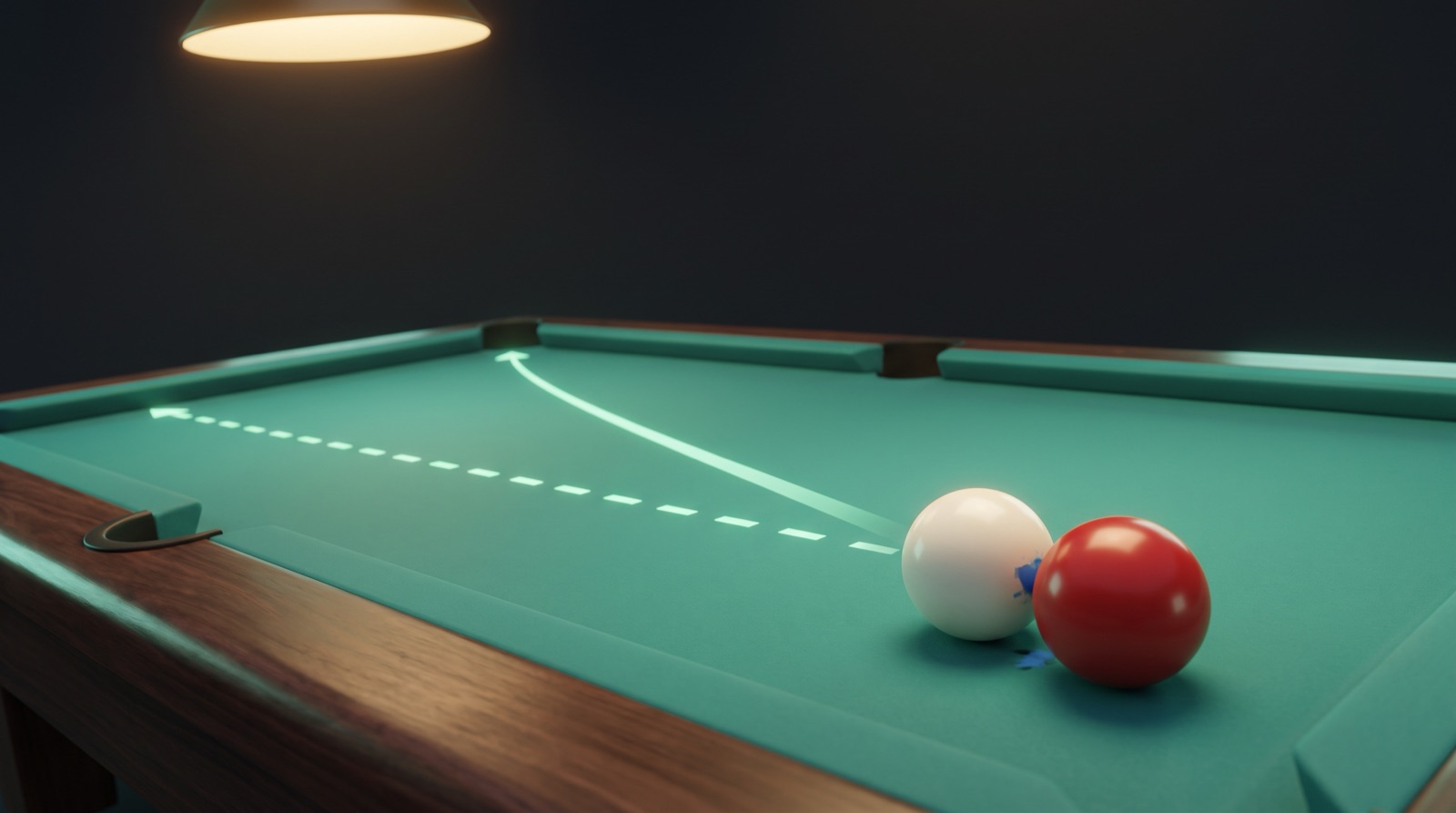
Throw is the small angle friction adds when the cue ball rubs across an object ball at contact. Instead of leaving exactly along the line through the two centres, the object ball gets dragged a little in the direction the cue ball is sliding — usually a degree or a few, and most on soft cut shots near a half-ball hit. It is why a slow cut can miss on the fat side when your aim was geometrically perfect. The fixes are simple: aim a touch thinner, hit a little firmer, or add outside english.
01
Aiming systems assume the balls are frictionless
Every aiming method you have learned rests on one idealisation. Put the cue ball in the ghost-ball position, touching the object ball on the line to the pocket, and the object ball will leave along the line joining the two centres. That is true for perfectly slippery balls. Real balls are not perfectly slippery.
On any shot other than a dead-straight one, the cue ball does two things at the instant of contact. It pushes into the object ball along the line of centres, and its surface slides sideways across the object ball’s surface. The push is what sends the object ball away. The slide is what causes throw: friction at that contact point grabs the object ball and tugs it a little way along with the cue ball.
Contact lasts a tiny fraction of a second, so the tug is small. But it happens before the object ball has gone anywhere, which means any change in its direction gets multiplied by the whole distance to the pocket.
02
Cut-induced throw: why slow cuts come up short
Picture a cut to the left. The cue ball arrives travelling roughly straight up the table and meets the object ball on its right side. As it pushes the object ball away to the left, its surface is sliding forward across the object ball. Friction drags the object ball forward too, rotating its path slightly toward the direction the cue ball was going.
The result is always the same: the object ball leaves at a slightly smaller cut angle than the geometry says. You aimed for a thirty-degree cut and got something closer to twenty-eight. Players call that an undercut, and it shows up as a ball that catches the cushion on the fat side of the pocket.
If your long shots are generally fine but your soft cuts keep missing on the same side, that pattern is throw, not bad aim. Random aiming errors scatter both ways. Throw only ever pulls one way.
03
How big the effect really is
Throw is rarely more than a few degrees, and on many shots it is well under one. It peaks somewhere around a half-ball hit. On a nearly straight shot there is almost no sideways slide, so there is nothing for friction to work on. On a very thin cut the balls barely press together, so friction has almost nothing to grip with. The middle cuts get both ingredients at once.
Small angles still matter because of distance. One degree of error moves a ball about 1.7 centimetres off line for every metre it travels. Over a long shot, where the usable width of a pocket is only a few centimetres, a two-degree throw is the difference between the centre of the pocket and the point of the jaw.
04
Side spin changes the rub
English adds a second source of sliding at the contact point, because the cue ball’s surface is now turning as well as travelling. Whether that helps or hurts depends on which side you hit.
Inside english is spin on the side of the cue ball toward the direction you are cutting. Its surface turns the same way the cue ball is already sliding, so the rub gets bigger and so does the throw.
Outside english turns the surface the other way, against the slide. A little of it reduces throw, and the right amount cancels it almost completely: the two balls meet like a pair of gears, with no slip at all. Players sometimes call that gearing english. Put on more than that and you overshoot, throwing the object ball the other way.
English also produces throw on a straight-in shot, where the cut ingredient is absent. Right-hand english rubs the object ball to the left; left-hand english rubs it to the right. This is separate from squirt and swerve, which bend the cue ball’s own path before it arrives. Throw happens only at the moment the balls touch.
05
What makes throw bigger or smaller
Speed. Friction between pool balls is stronger when the surfaces slide past each other slowly. A soft shot therefore throws more than a firm one along the same line, which is the single most useful thing to know about throw.
Stun versus roll. A cue ball that is still sliding at contact generally throws more than one that has settled into a natural roll, on the same cut at the same pace.
Ball condition. Clean, polished balls throw less. Dirty balls throw more, and a smudge of chalk sitting exactly on the contact point can produce a dramatic extra kick that sends a ball well wide. That is one more reason to keep your chalk on the cue tip and off the table.
06
Using throw on purpose
Throw is not only an error to correct. It makes shots that pure geometry says are impossible.
The classic example is a pair of frozen object balls whose line misses the pocket by a little. Hit the first ball straight through the line and the second ball goes where the line points, which is the rail. Hit the first ball with a cut instead, and it rubs across the second ball as it moves, dragging it sideways. Cut the first ball toward the side you need the second ball to go, at a gentle to medium pace, and you can steer a combination several degrees off its natural line.
The same idea runs through ordinary combinations that are not quite frozen. Slow combinations throw more than fast ones, so if a combo needs a nudge, ease off the pace rather than adjusting your aim.
07
Allowing for throw without overthinking it
You do not need to calculate throw at the table. You need three habits. On soft cuts near a half-ball angle, aim a hair thinner than the ghost ball says. When a cut can be played firmly without wrecking position, play it firmly and let the effect shrink. When it must be played softly, consider a touch of outside english to take the rub out.
The quickest way to build the feel is a single drill. Set up a half-ball cut into a corner pocket and shoot it ten times at a slow pace, then ten times at medium pace, noting where each ball enters the pocket. The gap between the two groups is your table’s throw, measured in your own hands.
That drill only teaches something if the table behaves the same way every time. Duel models both cut-induced and english-induced throw in its fixed-step physics, deliberately scaled down to keep it forgiving, so the direction of the effect is right but its size is smaller than on real cloth. Use a simulator to build the habit of reading which way a shot will throw, and a real table to calibrate how much.
08
Common questions
What is throw in pool?
Throw is the small change in an object ball's direction caused by friction between the cue ball and the object ball at the moment of contact. Instead of leaving exactly along the line through the centres of the two balls, the object ball is dragged slightly in the direction the cue ball surface is sliding across it. The effect is usually a few degrees or less, but that is enough to miss a pocket on a long shot.
Which way does a cut shot throw?
A cut shot throws the object ball toward the direction the cue ball is travelling, so the ball leaves at a slightly smaller angle than the geometry predicts. The practical result is an undercut, where the ball goes a little fuller than you aimed. That is why players learn to aim a touch thinner than the pure ghost-ball position on soft cuts.
How do you compensate for throw in pool?
Aim slightly thinner than the pure geometric line on cut shots, especially soft ones close to a half-ball hit. You can also reduce throw by hitting a little firmer or by using a small amount of outside english, which cancels the sideways rub between the balls. Practising the same cut at different speeds is the fastest way to learn how much allowance your table needs.
Does outside english reduce throw?
Yes. Outside english spins the cue ball so its surface moves against the sideways slide at the contact point, which reduces cut-induced throw, and the right amount removes it almost completely. Inside english does the opposite and adds to the throw. Too much outside english overshoots and throws the object ball the other way.
Why do slow shots throw more than fast shots?
Friction between pool balls is stronger when the surfaces slide past each other slowly, so a soft shot gets more grip at contact than a firm one. A sliding cue ball also tends to throw more than one that is already rolling naturally. That is why a soft cut that feels perfectly aimed can still miss while the same line struck firmly goes in.
How do you throw a frozen ball into a pocket?
When two object balls are touching but the line through them misses the pocket slightly, hitting the first ball off-centre makes it rub across the second and drag it sideways. Cut the first ball toward the side you want the second ball to move. Play it at a gentle to medium pace, because slower contact produces more throw.