
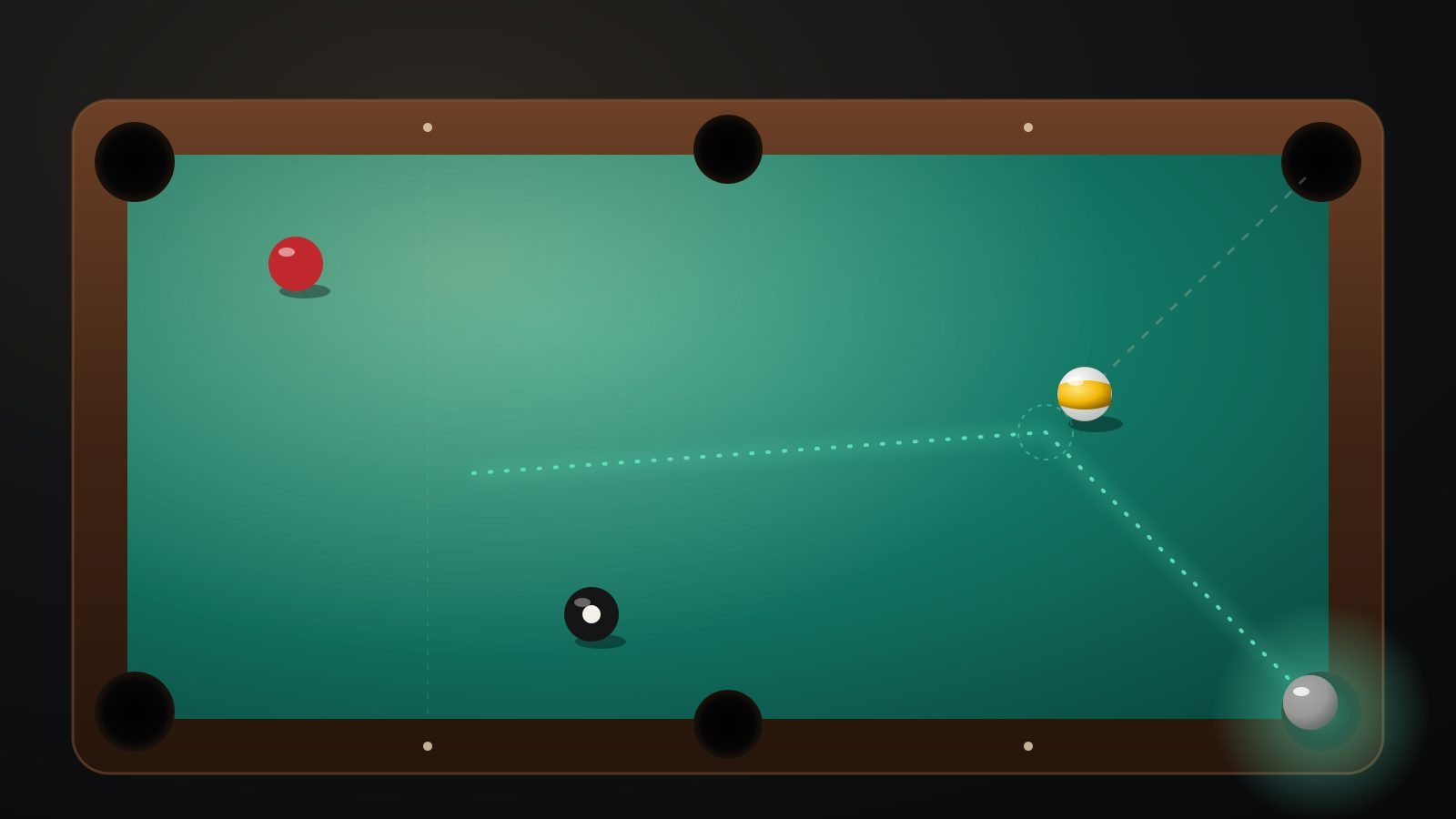
A scratch in pool is when the cue ball goes into a pocket or off the table. It is a foul: your turn ends immediately and your opponent gets ball in hand. It is not a loss on its own — the only scratch that ends the game is one that happens on the same shot as the 8-ball going down. Everything else is a turn handed over, and almost every scratch can be seen coming before you pull the trigger.
01
What counts as a scratch
Two things, and only two. The cue ball drops into any pocket, or the cue ball leaves the playing surface — over a rail, onto the floor, or coming to rest on top of a rail or light fitting. Both are handled identically.
People also say “scratch” loosely for any foul: missing every ball, hitting the wrong group first, or failing to get a ball to a cushion after contact. Those are fouls with exactly the same penalty, but they are not scratches. The distinction matters in one place only: when you are arguing about the break, where the rules treat a scratch and other fouls slightly differently.
02
The penalty: ball in hand
After a scratch your turn is over and your opponent takes the cue ball in hand. Under the standard World Pool-Billiard Association rules that most leagues and tournaments use, they may place it anywhere on the table, then shoot at any ball in their group from wherever they like.
Many bar and house rules soften this to ball in hand behind the head string — the line across the table at the second diamond from the breaking end, also called the kitchen. The incoming player must place the cue ball in that zone and, in most versions, shoot at a ball outside it. It is a much smaller penalty, which is why the difference is worth settling before the first rack rather than after the first scratch.
A scratch rarely loses a game because of the turn you lose. It loses games because a competent opponent with the cue ball in their hand can usually run out. Treat avoiding scratches as a defensive skill, not just a tidiness one.
03
What happens to the balls that went down
If you pocket one of your own balls and the cue ball follows it in, the object ball stays pocketed. You do not get credit in the sense of continuing your turn, but you do not lose the ball either. Balls from your opponent’s group that dropped on the same shot also stay down, which is occasionally the only good news in a bad shot.
The exception is the 8-ball, covered below. A few old bar rule sets also make the player who scratched spot one of their pocketed balls back on the table as an extra penalty. That is a house rule, not part of the official game.
04
Scratching on the break
A scratch on the opening break is a foul, but a forgiving one. Under the standard rules, any balls that went down stay down, the table remains open — no one has solids or stripes yet — and the incoming player gets ball in hand behind the head string rather than anywhere. This is one of the few places where the modern rules still restrict where the cue ball goes.
If the 8-ball also drops on a scratching break, the incoming player chooses: re-spot the 8 and shoot with ball in hand behind the head string, or re-rack and break themselves. Under the standard rules it is not a loss for the breaker, although plenty of bar rules call it one, so check.
05
Scratching on the 8-ball
This is the scratch that actually costs games, and it is the source of most rule arguments. The rule is narrow: you lose if the 8-ball and the cue ball are both pocketed on the same shot, at any point after the break. If you scratch while shooting at the 8 and the 8 stays on the table, it is an ordinary foul and your opponent gets ball in hand.
You also lose by knocking the 8 off the table, or by pocketing it before your group is cleared, regardless of the cue ball. Those are separate rules that happen to sit next to the scratch rule in most people’s memories.
06
Why the cue ball keeps finding the pocket
Scratches feel like bad luck. They are almost never luck. After the cue ball hits an object ball, its path is predictable from two things: where it struck the object ball, and what it was doing at the moment of contact.
The 90-degree rule. If the cue ball is sliding with no spin when it hits — a stun shot — it leaves along the tangent line, at right angles to the path the object ball takes. Lay your cue across the object ball at 90 degrees to its line into the pocket and you are looking at where the cue ball will go. If that line points at another pocket, you are about to scratch.
The 30-degree rule. A cue ball that is naturally rolling by the time it arrives does not travel the tangent line for long. Topspin bends it forward, and for a half-ball hit it ends up heading about 30 degrees away from its original direction. This is why a soft, rolling cut shot into a corner so often carries the cue ball into the side pocket.
Straight-in shots. The most common scratch of all. Hit a dead-straight shot with any follow and the cue ball rolls straight after the object ball, into the same pocket. Every beginner has done it; the fix is the stop shot.
Most players aim the object ball and never look at the cue ball’s exit line. Take two seconds to trace it before you get down. Nearly every scratch you will make this year is visible in that line.
07
How to stop scratching
Once you can see the line, you can bend it. Spin and speed are the two controls.
Use draw or follow to steer off the tangent. Draw pulls the cue ball back from the tangent line, follow pushes it forward. If the stun line runs at a pocket, a touch of either moves the exit point along the rail and away from the jaws. On a straight-in shot, hit slightly below centre so the cue ball arrives sliding and stops dead.
Change the speed. Many scratches only happen because the cue ball has enough pace to reach the pocket. A softer shot that dies a foot short of the corner is a perfectly good shot. Equally, a firmer shot can carry the cue ball past a side pocket it would have dribbled into.
Respect the side pockets. The middle pockets catch more scratches than they should because cut shots down the long rail send the cue ball straight across them. When the exit line crosses the middle of the table, decide on purpose which side of the side pocket it passes.
Keep the cue level. Cue balls leave the table when they are struck downward and jump, or when they hit an object ball high and hard. Keep the butt of the cue as low as the rail allows and save power for shots that need it.
The quickest way to build this is to set one cut shot up and play it ten times with stun, follow, and draw, watching where the cue ball finishes each time. It only teaches anything if identical shots produce identical results, which is why Duel runs its physics on a fixed time step: the same aim, power, and spin always send the cue ball to the same place, so a scratch in practice mode is your shot and not a dice roll.
08
Common questions
What is a scratch in pool?
A scratch is when the cue ball goes into a pocket or leaves the table. It is a foul in every common version of pool, so your turn ends and your opponent gets ball in hand. Missing every ball or hitting the wrong ball first are also fouls, but strictly speaking they are not scratches.
What happens when you scratch in pool?
Your turn ends and your opponent takes ball in hand. Under standard WPA rules they can place the cue ball anywhere on the table; many bar and house rules restrict them to behind the head string instead. Any object balls you pocketed on the scratch shot stay down, except the 8-ball.
Do you lose if you scratch on the break?
No. A scratch on the break is an ordinary foul: balls you pocketed stay down, the table stays open, and your opponent gets ball in hand behind the head string. The only break scratch that can cost you more is one where the 8-ball also goes down, and even then standard rules let your opponent choose to re-spot the 8 or re-rack rather than awarding them the game.
Do you lose if you scratch on the 8-ball?
Only if the 8-ball is pocketed on the same shot. If you scratch while shooting at the 8 and the 8 stays on the table, it is a normal foul and your opponent gets ball in hand. Pocketing the 8 and the cue ball together, after the break, loses the game.
Do you have to spot a ball if you scratch?
Not under standard rules. In 8-ball, a scratch costs you the turn and gives your opponent ball in hand, and that is the whole penalty. Some older bar rules make the player who scratched return one of their pocketed balls to the table, but that is a house rule to agree on before the game, not part of the official rules.
How do you stop scratching in pool?
Before every shot, trace where the cue ball will travel after contact and check that line for a pocket. On a stun shot it leaves at 90 degrees to the object ball’s path; with follow it bends forward toward the object ball’s path, and with draw it bends back. If the line points at a pocket, change the spin or the speed until it doesn’t.